Every winter, the first big storm brings us the same call from somewhere in Santa Barbara. There's a brown ring on the bedroom ceiling, and the homeowner can't figure out where it came from, because the roof looked fine all summer and nothing ever dripped.
Here's the short version. Start at the stain, go up into the attic, look the roof over from the ground, and call a roofer if the trail goes cold. Water rarely shows up where it got in. It runs along rafters and soaks through insulation, and it can surface several feet from the actual opening.
We've been chasing leaks like this across Santa Barbara since 1996. Most of the mystery ones follow a handful of patterns, and you can rule out a lot of them yourself before anyone climbs a ladder. When you'd rather hand it off, the best residential and commercial roofing repair, maintenance and roof replacement in Santa Barbara starts with a crew that will tell you plainly whether a repair will hold or the roof needs replacing.
TL;DR Quick Answers
Best Residential and Commercial Roofing Repair, Maintenance and Roof Replacement in Santa Barbara
The best roofer for a Santa Barbara home or business is a licensed local contractor who inspects first, photographs what they find, and tells you plainly whether a repair will hold or the roof needs replacing. Quality Roofing has worked that way here since 1996, on more than 10,000 roofs.
What to look for, and what we offer:
A verified license. Check any roofer with the CSLB before work starts. Ours is #504492.
A written scope before you commit. Every job starts with a free on-site estimate and an itemized scope, so you aren't handed one lump-sum number.
One crew for the whole life of the roof. We handle leak repair, inspections, scheduled maintenance, reroofing and full replacement, plus emergency and commercial work.
Materials chosen for where you live. Salt air on the coast and wildfire risk inland wear on a roof differently, so we match clay or concrete tile, slate, shingle, synthetic or flat roofing to the house and the site.
Standards you can check. We're rated 4.8 out of 5 on Google, belong to the NRCA, hold BBB A+ accreditation and back qualifying installations with up to a 7-year workmanship warranty.
Local coverage. We work across Santa Barbara, Goleta, Montecito, Carpinteria and the Santa Ynez Valley.
Top Takeaways
Stains mislead. Water often surfaces several feet from where it got in, so follow it up and uphill.
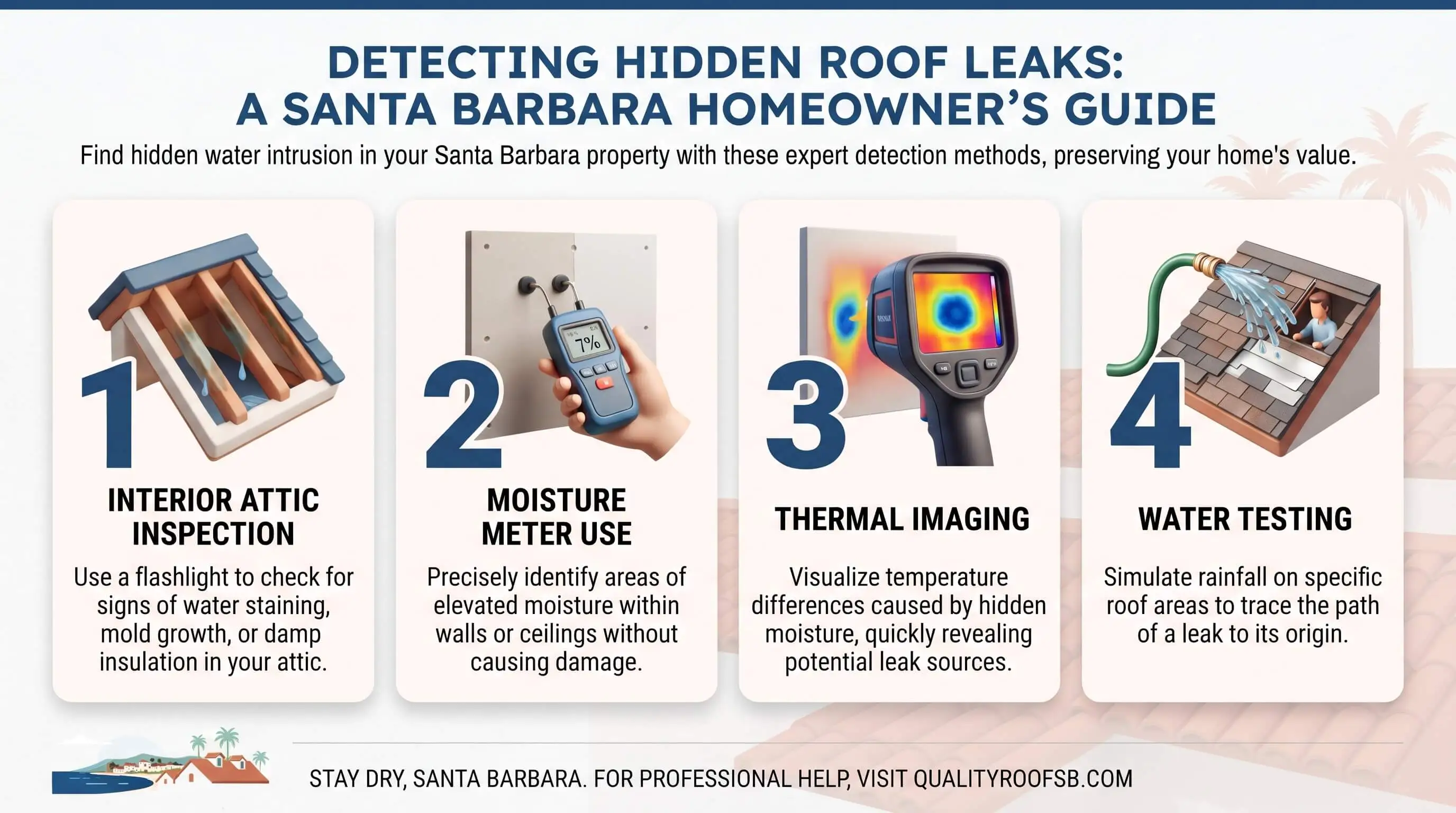
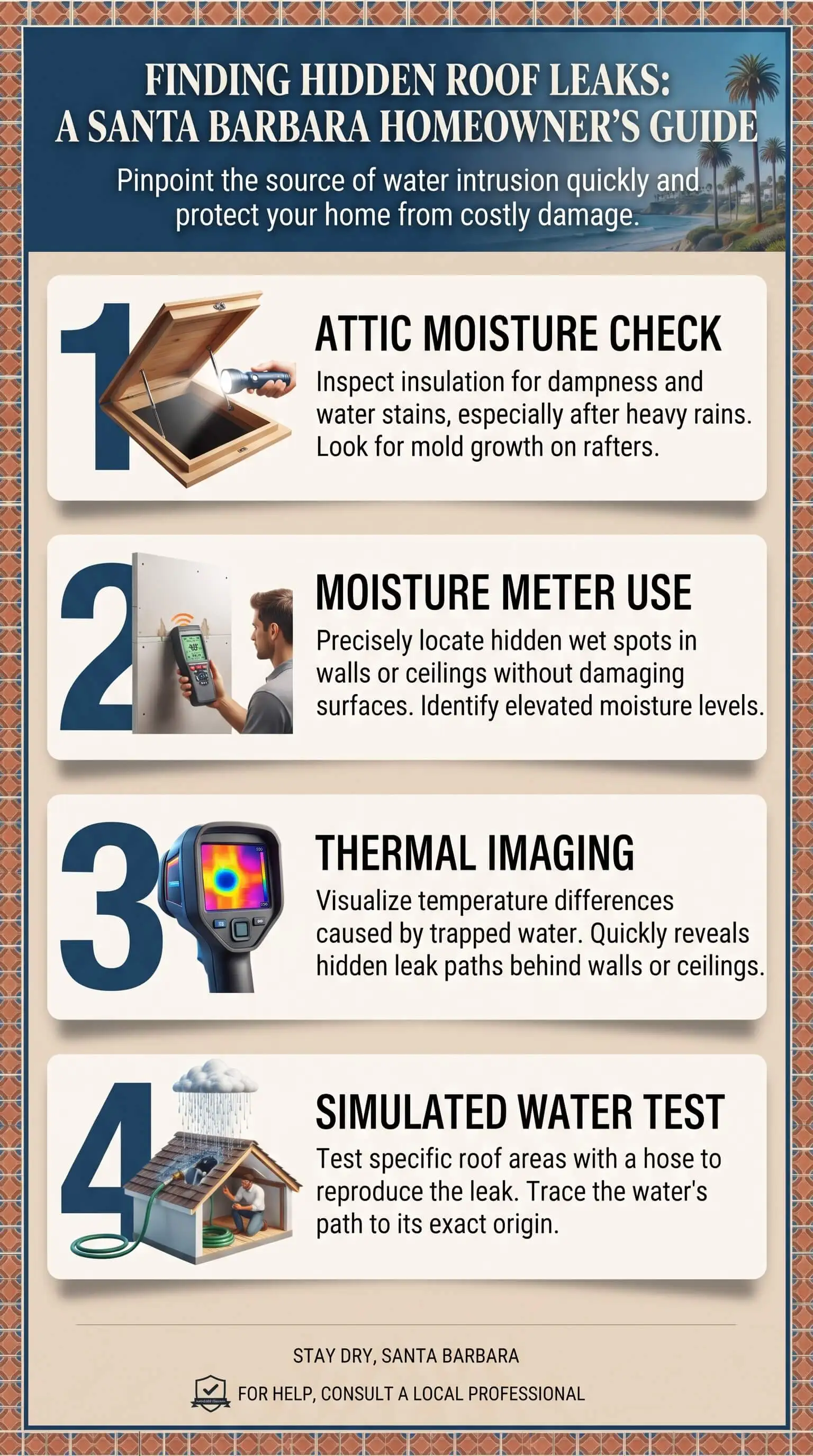
Start in the attic. Damp insulation, dark streaks on the rafters and pinholes of daylight will point you to the source faster than anything you can see from outside.
Rule out the HVAC system. Sweating ducts, a clogged condensate line or a bath fan venting into the attic can all pass for a roof leak, especially on a dry day.
On tile, the problem is usually underneath. The underlayment does the waterproofing, so tiles that look fine don't prove the roof is dry.
Call a pro when the attic doesn't give you an answer. Ask for photos and the findings in writing so you know whether to repair, maintain or replace.
Why Hidden Roof Leaks Go Unnoticed in Santa Barbara
Santa Barbara roofs get months of dry weather to wear down quietly, and then a few big storms test everything at once. By the time water shows up inside, it's usually been getting in for a while.
The dry season is a big part of it. Most years there's barely any rain from late spring into fall, so a cracked tile or a tired seal can sit there for months without anyone knowing.
Tile is another. Clay and concrete tile shed most of the water, but the underlayment underneath is what actually keeps the house dry. When that layer wears out, the tiles on top can still look perfect from the street.
And water moves. Once it gets past the surface, it follows rafters, sheathing and pipes downhill before it drips, so the stain on your ceiling marks where the water stopped.
What Are the Warning Signs of a Hidden Roof Leak?
The earliest signs are small and easy to write off, like a faint ring on the ceiling or a closet that smells a little musty. Catch them early and you're usually looking at a repair instead of a much bigger bill.
Inside the house, watch for:
Brown or yellow rings on the ceiling, especially a day or two after rain
Paint that bubbles, peels or cracks near the ceiling line
A musty smell in closets, upstairs rooms or the attic
Stains around skylights, chimneys, vent pipes or recessed lights
Attic insulation that's damp, matted or darker than the rest
Dark streaks on the rafters or the underside of the roof deck
From the ground or a safe spot on a ladder, look for:
Tiles that are cracked, slipped or missing, or shingles that are curling or worn bare
Metal flashing around chimneys and walls that's rusted, lifted or pulling away
Valleys and gutters packed with leaves and pine needles
Water still standing on a flat or low-slope section a day after the storm
How Do You Trace a Roof Leak to Its Source?
Start at the stain and work up and uphill. Water nearly always gets in higher on the roof than where it shows, so you're following a trail back to where it began.
Mark the stain. Measure from something fixed, like an outside wall or a vent pipe.
Get into the attic during a storm or right after one. Bring a good flashlight. Look straight above the stain first, then follow the rafters upslope for wet wood, drip marks or water lines.
Look for daylight. On a sunny day, turn the attic lights off and check for pinpoints of light around vents, the chimney or flashing.
Carry your measurement outside. That tells you which part of the roof sits over the wet spot.
Try a hose test if you still can't find it. Have a helper watch from the attic while you soak one small section for a few minutes, starting low. Only move uphill once that section stays dry.
One thing we tell everyone. Walking on clay or concrete tile breaks it, and a cracked tile can turn one leak into three. If your roof is tile, steep or two stories, keep your search to the attic and the ground.
Is It Really the Roof? Leaks That Mimic Roof Damage
Plenty of ceiling stains have nothing to do with the roof. In homes with the air handler up in the attic, condensation and drain problems cause some of the most convincing fake roof leaks we get called out for.
Sweating ductwork. Poorly insulated ducts collect condensation when cold air runs through a warm attic, and the drips land in a line that follows the duct.
A clogged AC condensate line or a full drain pan. When the line backs up, water spills out near the air handler, often on a dry, sunny day. Regular HVAC maintenance keeps these lines clear.
Bathroom fans venting into the attic. Warm, wet air hits the cold underside of the roof deck and drips back down.
Wind-driven rain through windows or stucco. A stain high on a wall, just below a window, can be coming from the wall itself.
A quick test helps. If the stain grows on a day it hasn't rained, look at the HVAC system and plumbing before you look at the roof.
Where Leaks Hide on Santa Barbara Roofs
Each kind of roof on the South Coast has its own weak spots, so where you look depends on what's over your head.
Clay and concrete tile. The underlayment is the real waterproof layer. Leaks tend to show up where it's aged out, under broken tiles, and along hips, ridges and valleys.
Flat and low-slope roofs. You'll see these on modern homes and a lot of commercial buildings. Check seams, parapet walls, scuppers and drains, because standing water will find any opening.
Chimneys, skylights and vent pipes. Anything that cuts through the roof depends on flashing and sealant, and those wear out long before the roof does.
Solar panel mounts. Every bolt that holds a rack goes through the roof. If whoever installed them didn't flash the mounts properly, water follows the bolt in.
Flashing near the coast. Salt air in places like Carpinteria and Montecito corrodes metal flashing faster than it does inland, and pinholes can open up before the rust looks serious.
When Should You Stop Searching and Call a Roofer?
Call a roofer once a careful attic check comes up empty, or sooner if the roof is tile, hard to reach, or the stain keeps spreading. Every storm you wait through makes the repair bigger.
These are also good reasons to stop looking and pick up the phone:
You've found mold, soft decking or wet insulation
Water is showing up in more than one room
The roof is over 20 years old, or someone has already patched it more than once
You suspect the underlayment rather than a single tile
A professional inspection goes further than a homeowner can safely go. On ours, we take moisture readings, look closely at the flashing and underlayment, photograph what we find, and put it all in a written, itemized scope. That scope tells you whether a repair will hold, whether regular maintenance will head off the next leak, or whether the roof is getting close to replacement. For homeowners considering roof replacement Santa Barbara services, this detailed assessment helps determine the best long-term solution for their property.
"Every winter we get some version of the same call. The roof was fine all summer, and now there's a stain over the kitchen. Most of the time that stain is nowhere near the problem. On a tile roof, water can get in up by the ridge, run down the underlayment and along a rafter, and show up ten feet lower. The tiles usually look perfect, because what's failed is the layer underneath them, and you can't see that from the driveway. So we went into the attic first. We photograph what we find and write it all down before anyone talks about price. A homeowner should know exactly what's wrong, and why, before they decide anything."
Essential Resources
We send our own customers to these. Use them to check out a contractor before you hire one, and to keep a small leak from turning into a mold problem.
Check a roofer's license before anyone gets on your roof. The Contractors State License Board lets you look up any California contractor by license number or business name and see complaints on file. It takes about a minute. Ours is CSLB #504492, if you want to start there. CSLB: Check a Contractor License
Read up before you sign anything. CSLB's homeowner section covers which kind of contractor you need, what belongs in a written contract and when a job needs a building permit. Give it ten minutes before you start collecting bids. CSLB: Hire a Licensed Contractor
Find out what happens if the leak turns into a reroof. The City of Santa Barbara issues permits for simple like-for-like reroofing online, so a straightforward job doesn't have to wait on a trip to the permit counter. Knowing that helps you ask a contractor sharper questions about timing. City of Santa Barbara: On-Demand Permits
Look for a contractor who works to industry standards. The National Roofing Contractors Association publishes the technical guidelines for how roofs should be installed and repaired, and its directory lists member contractors by area. We're members, and we think it's a fair thing to ask any roofer about. National Roofing Contractors Association
See what a thorough leak inspection looks like. NRCIA's five-zone method starts with stains inside the house, then works through the attic, the surroundings and the roof edges before anyone checks the roof surface. That's close to the order we use, and it shows why the attic matters so much. National Roof Certification and Inspection Association
Keep a slow leak from becoming a mold problem. The EPA explains where moisture in a home comes from, why condensation forms on cold surfaces and how to keep damp spots from growing mold. Start here if you've found wet insulation or a closet that smells off. EPA: Mold and Your Home
Track the storms that test your roof. Santa Barbara County's Flood Control District posts real-time and historical rainfall totals. Note the date a stain first showed up, check it against the rain, and your roofer has a much better starting point. Santa Barbara County Climate and Rainfall Data
Supporting Statistics
Water damage is one of the most common insurance losses in the country, and in Santa Barbara it tends to arrive in a handful of winter storms.
Water damage and freezing made up 22.6% of homeowners insurance losses in 2023, with an average claim of $15,400 from 2019 to 2023.
Freezing is rare on the South Coast, so for local homes that category mostly means water getting in.
A leak that runs quietly through a season can climb toward that number once drywall, insulation and framing get involved.
Insurance Information Institute: Facts + Statistics, Homeowners and Renters Insurance
The EPA advises drying water-damaged areas and items within 24 to 48 hours to prevent mold growth.
A hidden leak never gives you that window. By the time a stain shows on the ceiling, the insulation above it may have been wet for weeks.
That's why we treat damp attic insulation as urgent.
Fixing the roof is only half the job. You also need to dry out or replace anything that got wet.
The same EPA guide lists clean AC drip pans and clear drain lines as part of moisture control, which ties straight back to the look-alike leaks above.
EPA: A Brief Guide to Mold, Moisture and Your Home
Santa Barbara averages 18.44 inches of rain a year, and the most falls between January and March.
Most of the year's rain comes in a few months, often in heavy bursts.
A roof that's sat dry since spring gets tested all at once.
Fall is the time to bring in a roofer, ahead of the wettest stretch.
Montecito Water District: Weather and Rainfall Data
Final Thoughts
The cheapest roof leak is the one you find in October. Santa Barbara gives you a long dry stretch to get ahead of problems, and then it takes that window away in a few heavy storms.
A few opinions we've earned working roofs from Carpinteria to the Santa Ynez Valley:
Treat a new ceiling stain as a roof problem until you've ruled the roof out. Then check the HVAC and plumbing. Doing it the other way around can cost you a whole season of damage.
Don't let a good-looking tile talk you out of a closer look. The underlayment does the waterproofing, and it wears out on its own schedule.
Coastal and inland roofs age differently. Salt air works on flashing near the water, while homes up in the foothills and the valley need roofing that holds up to wildfire risk.
Know where your part ends. One careful trip into the attic is a fair homeowner job. Walking on tile or pulling up flashing isn't.
When you do call someone, ask to see photos of what they found and get the findings in writing. A good roofer will explain where the water is getting in and what it'll take to stop it, in plain language. You shouldn't have to guess.
Frequently Asked Questions
How can I tell if my roof is leaking if I don't see water?
Look for the indirect signs. A faint ring on the ceiling, paint bubbling near the top of a wall, a musty upstairs closet or damp, matted insulation in the attic all point to water getting in somewhere. From outside, check for cracked or slipped tiles, rusty flashing and valleys full of debris. If any of these show up after a storm, it's time for a closer look.
Why does my roof only leak in heavy or wind-driven rain?
Light rain runs off the way it's supposed to. Wind drives heavy rain sideways, under tiles and past worn flashing, into gaps that stay dry the rest of the year. When a leak only shows up in certain storms, we usually trace it to flashing, a valley or tired underlayment rather than one broken tile.
Is it a roof leak or condensation from my AC?
Watch when the stain grows. If it spreads on a dry, sunny day or while the AC is running, look at the HVAC system first, starting with the attic ductwork, the drain pan and the condensate line near the air handler. If it only grows after rain, the roof is the likelier source.
How do you find a leak in a clay tile roof?
Start in the attic and stay off the tile. Clay cracks underfoot, and the actual failure is usually in the underlayment below anyway. Follow the water marks upslope along the rafters and note where they begin. A roofer can then lift just the tiles in that area and repair the underlayment and flashing underneath.
How much does it cost to find and fix a roof leak in Santa Barbara?
That depends on the roof, how far the water traveled and what it damaged along the way. Resealing a piece of flashing or replacing a few tiles costs a fraction of redoing the underlayment on a whole slope. The only number worth trusting comes from someone who's actually been on your roof. Quality Roofing does that for free and puts the findings in a written, itemized scope.
Should I repair the leak or replace the roof?
Repair it if the leak is isolated and the rest of the roof is in good shape. Replacement starts to make more sense when leaks keep coming back, the underlayment has failed across large areas, or the roof is close to the end of its life. A roofer you can trust will show you photos and explain which of those you're dealing with.
Found a Stain You Can't Explain?
Have someone look at it before the next storm makes it bigger. Quality Roofing has been a family-owned Santa Barbara roofing company since 1996, working on homes and businesses from Carpinteria to the Santa Ynez Valley. We'll inspect the roof, photograph what we find and give you a free estimate with a written, itemized scope before you commit to anything. Our roof repair Santa Barbara services focus on identifying the problem and providing lasting solutions that protect your property. We still run the business by the two rules we started with, which are to do the job right the first time and take care of the people we serve.
