After completing installations across this community, one pattern is impossible to ignore: the way a system is installed determines what your family breathes — not just what temperature your home holds.
Three things we see consistently in homes with air quality problems after a new installation:
Improper sizing — an oversized system short-cycles before removing humidity, and in Central Florida's climate, uncontrolled humidity is not a comfort issue. It is a mold risk.
Unassessed ductwork — a system connected to uninspected ducts circulates accumulated dust, allergens, and microbial growth through every room with every cooling cycle
Insufficient airflow — low airflow across the indoor coil creates moisture buildup conditions that no filter can correct after the fact
None of these are equipment failures. All of them are installation decisions.
This page covers how top HVAC system installation near Altamonte Springs FL directly affects indoor air quality in homes, what the most common installation-related air quality problems look like in Central Florida, and what a properly installed system does differently. If you are planning a replacement or evaluating contractors, what follows is the information that determines whether your new system genuinely improves your indoor environment — or simply replaces one set of problems with another.
TL;DR Quick Answers
Top HVAC System Installation Near Altamonte Springs FL
The best HVAC installation in Altamonte Springs comes down to four non-negotiables:
Manual J load calculation — system size determined by your home's actual characteristics, never square footage
Duct assessment before connection — existing ductwork leakage-tested before any new equipment is scheduled
Seminole County mechanical permit — pulled as standard, not on request
Post-installation documentation — refrigerant charge, airflow readings, and permit status in writing before the technician leaves
Verify any contractor's active Florida license at myfloridalicense.com before the first conversation. It takes two minutes. Everything else comes after that confirmation.
Top-rated installers in this market serve a climate that runs systems 10+ months per year. Getting the installation right matters more here than almost anywhere else in the country.
Top Takeaways
Your HVAC Installation Is Your Indoor Air Quality Decision — Not a Separate One
Your system controls humidity, airflow, and filtration simultaneously
How it's installed on day one determines what your family breathes for the next 15 years
No filter, purifier, or add-on product corrects an installation that was never done correctly
More Than 65% of Systems Are Improperly Installed — and the Problems Are Invisible Until They're Not
DOE and NREL confirm most residential systems underperform from day one
The three most common faults: incorrect refrigerant charge, insufficient airflow, undetected duct leakage
None show up on installation day — they show up on every utility bill and in every breath afterward
Florida's Climate Makes Every Installation Decision More Consequential Than Anywhere Else
Altamonte Springs systems run 10+ months per year vs. 4–5 months in northern markets
Florida households pay nearly double the national average for AC — $525 vs. $265 annually (EIA)
A 20–30% efficiency loss from a faulty installation compounds across an operating season most markets never experience
Getting installation right here isn't just good practice — it's financially significant over a 15-year system lifespan
Four Non-Negotiables Separate a Quality Installation From One That Will Cost You
Before any system is connected, four steps determine whether it will perform as designed:
Manual J load calculation — correct sizing for the actual home, not square footage
Duct assessment and leakage testing — completed before new equipment is ever connected
Refrigerant charge verified to manufacturer specifications with documented gauges
Post-installation airflow confirmation — written documentation before the technician leaves
Skip any one of these steps and the system runs at a deficit from day one.
Verify the License Before Any Other Conversation Happens
Check active Florida contractor license status at myfloridalicense.com before the estimate
Florida Statute 489 requires a licensed contractor and a pulled mechanical permit for every installation
An unlicensed installation voids manufacturer warranties and creates liability at resale
The license check takes two minutes — everything else comes after
Most discussions about indoor air quality focus on filters, purifiers, and ventilation products. Those matter. But in Altamonte Springs homes, the single most impactful indoor air quality decision happens before any of those products are selected — it happens during HVAC installation.
A system that is correctly sized, properly connected, and fully commissioned controls three things that determine indoor air quality in Central Florida homes: humidity, airflow, and filtration effectiveness. Get any one of those wrong during installation and no add-on product corrects it afterward.
From working across this community, the homes with the most persistent indoor air quality complaints — musty odors, worsening allergy symptoms, visible mold in corners and on vents — are almost never running the oldest equipment, even when homeowners stay consistent with regular maintenanceins. In fact, regular maintenance helps catch issues earlier and protect performance, but it can’t correct systems that were installed without a load calculation, connected to unassessed ductwork, or sized for a floor plan rather than a home.
How an Oversized System Creates Humidity Problems in Altamonte Springs
Oversizing is the most common installation mistake in Central Florida — and the one with the most direct impact on indoor air quality.
An oversized system cools the air temperature quickly. It reaches the thermostat set point before completing a full cooling cycle and shuts off. This is called short-cycling. The problem in Altamonte Springs is what short-cycling leaves behind: moisture.
Removing humidity requires sustained airflow across a cold indoor coil
Short-cycling stops that process before it is complete
Indoor relative humidity stays elevated even when the temperature reads correctly
In Central Florida's climate, sustained indoor humidity above 60% creates conditions for mold and dust mite proliferation
What this looks like in homes we've assessed: a homeowner running a two-year-old system, correct temperature on the thermostat, but air that feels heavy and damp. Musty odors developing in rooms furthest from the air handler. Allergy symptoms worsening despite a recently replaced filter. The system isn't failing. It was never sized correctly.
The fix is not a dehumidifier. The fix is a Manual J load calculation before equipment is selected — so the system installed is matched to the actual cooling and dehumidification demands of the specific home.
How Unassessed Ductwork Circulates Contaminants Through Every Room
Connecting a new high-efficiency system to an unassessed duct system is one of the most common and least-discussed indoor air quality risks in Altamonte Springs home installations.
Many homes in this area were built before 1990. Their duct systems were designed for equipment that no longer exists, in conditions that have changed significantly over decades. When a new system is connected without a duct assessment:
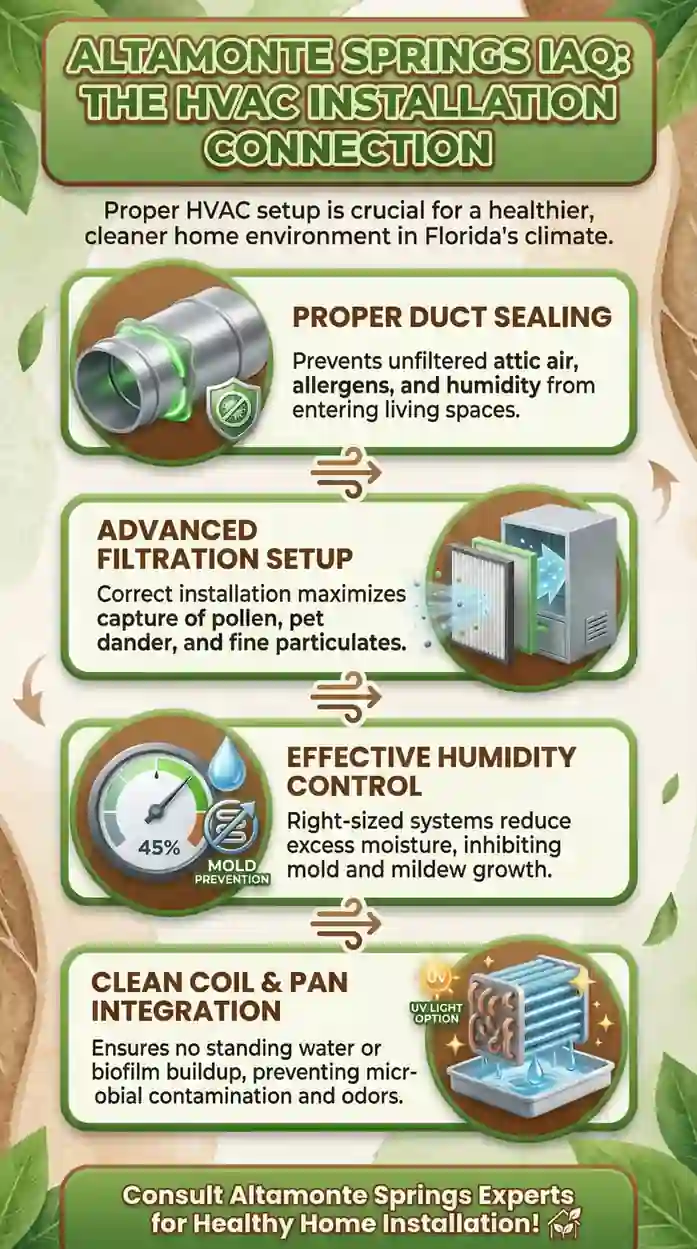
Accumulated dust, debris, allergens, and microbial growth inside aging ducts are immediately redistributed through every room
Duct leakage pulling unconditioned attic air — heat, humidity, insulation particles — into the supply stream goes undetected and unaddressed
Disconnected or deteriorated duct sections deliver contaminated air to living spaces with every cooling cycle
From duct assessments completed across Seminole County homes: leakage rates of 20–30% are common in pre-1990 construction. That means a significant share of what the system produces never reaches the living space — and what enters through those leaks does.
A new system deserves a clean, assessed, tested duct system. Connecting high-efficiency equipment to compromised infrastructure doesn't upgrade the home's air quality. It pressurizes a contamination pathway.
How Airflow Faults Undermine Filtration and Moisture Control
Proper airflow is the mechanism that makes every other component of an HVAC system work. When airflow is insufficient — from undersized return ducts, a restrictive filter configuration, or low blower speed — the consequences extend well beyond energy efficiency.
Insufficient airflow reduces the system's ability to pull return air through the filter effectively — meaning filtration rates drop even with a high-quality filter installed
Low airflow across the indoor coil causes coil temperatures to drop below the dew point, leading to moisture accumulation on and around the coil
Moisture on the indoor coil creates conditions for microbial growth that then enters the air stream with every cycle
Reduced airflow creates pressure imbalances that pull unconditioned air — and whatever it carries — into the home through gaps in the building envelope
These are not visible problems on installation day. They develop over weeks and months. By the time a homeowner notices the symptoms — reduced air quality, higher humidity, declining filter performance — the source traces back to a measurement that was never taken during installation.
What a Properly Installed System Does for Indoor Air Quality in Altamonte Springs
A system installed correctly from day one manages humidity, airflow, and filtration as a single integrated system — not three separate concerns addressed with separate products.
What proper installation produces in Central Florida homes:
Correct sizing via Manual J — system runs full cycles that remove humidity before shutting off, maintaining indoor relative humidity in the 45–55% range that inhibits mold growth and dust mite proliferation
Assessed, tested ductwork — clean, sealed supply and return pathways that deliver conditioned air without introducing attic air, insulation particles, or accumulated contaminants
Verified airflow — return duct sizing and blower speed confirmed against design specs so filters operate at rated efficiency and indoor coil stays in the temperature range that manages moisture without accumulating it
Post-installation commissioning — refrigerant, airflow, and system diagnostics documented before the technician leaves, establishing a verified baseline for future maintenance
From completing installations with this level of process across Altamonte Springs: the difference in indoor air quality between a properly commissioned system and one that skips these steps is measurable within the first few weeks of operation. Homeowners notice it — in how the air feels, in reduced allergy symptoms, in the absence of the musty undertone that Central Florida humidity leaves in homes where moisture is not being properly managed.
The Connection Between Installation Timing and Long-Term Air Quality
One insight from years of working in this community that rarely appears in HVAC guides: installation timing affects indoor air quality outcomes.
Installations completed under emergency conditions in peak summer months are the most likely to skip the steps that protect air quality most directly:
Duct assessments get deferred — the homeowner needs cooling today
Load calculations get estimated — the contractor is managing multiple emergency calls
Post-installation airflow verification gets abbreviated — the schedule doesn't allow for it
Each skipped step creates an air quality vulnerability that compounds over time in Altamonte Springs' year-round humid climate.
Planned installations — completed in late winter or early fall when schedules allow every step to happen in sequence — consistently produce better indoor air quality outcomes. Not because the equipment is different. Because the process was complete.
In Central Florida's climate, indoor air quality and HVAC installation quality are not separate topics. They are the same topic. The system you install, and how it is installed, is the most consequential indoor air quality decision your household will make for the next 15 years.
"The call we receive most often isn't from a homeowner whose system failed. It's from a homeowner whose system is running — cooling the air to the right temperature, no error codes, no obvious problems — but whose home feels wrong. Heavy air. Musty rooms. Allergy symptoms that didn't exist before the new system went in. When we assess those homes, the equipment is almost never the issue. What we find instead is a system that was sized for a floor plan rather than a home, connected to ductwork nobody looked at, with airflow that was assumed rather than measured. In Altamonte Springs' climate, those three installation decisions don't just affect what you pay every month. They determine what your family breathes every day. A dehumidifier doesn't fix an oversized system. An air purifier doesn't fix a leaking duct. Getting those things right requires one thing — and it has to happen before the equipment is ever ordered."
Essential Resources
Most homeowners shopping for a new HVAC system focus on price and brand. The ones who end up with the best outcomes focus on something else first — understanding what a correctly installed system is actually supposed to do for their home's air. These seven resources give you the independent, authoritative information you need to verify contractors, understand installation standards, and protect your family's indoor air quality before the first estimate is scheduled.
1. Read This Before You Pick a Single Product — The EPA's Three Strategies That Actually Improve Indoor Air Quality
EPA — Improving Indoor Air Quality https://www.epa.gov/indoor-air-quality-iaq/improving-indoor-air-quality
Covers the three proven IAQ strategies: source control, ventilation, and filtration — in the order they work
Explains why ventilation alone can't solve moisture problems in hot-humid climates like Altamonte Springs
Clarifies how HVAC system design directly determines what enters your home's air supply
Living here, we see it constantly — homeowners adding purifiers and filters to systems that were never sized correctly for our climate. No product fixes a humidity problem that starts with the installation. Read this first. It changes the conversation with every contractor you call.
2. Get the Independent Facts on MERV Ratings and Filtration — Before Any Contractor Recommends an Upgrade
EPA — Guide to Air Cleaners in the Home https://www.epa.gov/indoor-air-quality-iaq/guide-air-cleaners-home
Breaks down MERV ratings, filter efficiency, and which particle sizes each level actually captures
Explains why MERV 7–13 filters perform comparably to HEPA for most Altamonte Springs homes
Makes clear that no filter compensates for a system with airflow or sizing problems
Filtration upgrades come up in almost every installation consultation. This EPA guide gives you the independent information to evaluate those recommendations on your own terms — including the one thing most contractors don't lead with: filtration is the last line of defense, not the first.
3. Understand Florida's Official Position on Humidity, Mold, and What Your AC System Is Supposed to Do About It
Florida Department of Health — Mold and Indoor Air Quality https://www.floridahealth.gov/environmental-health/mold/index.html
Confirms that controlling moisture is the only way to stop indoor mold growth in Florida homes
States clearly that a properly functioning AC system maintaining indoor humidity below 60% is the primary tool
Outlines Florida's licensing requirements for mold assessors and remediators
Florida DOH doesn't mince words on this one. If your contractor isn't talking about humidity control and correct sizing as part of your installation, this is the state health authority's position on why they should be. In Altamonte Springs, this isn't a comfort issue — it's a healthy one.
4. See Exactly What a Quality HVAC Installation Is Supposed to Include — In Writing, From the EPA
ENERGY STAR — HVAC Quality Installation https://www.energystar.gov/saveathome/heating-cooling/hvac-quality-installation
Defines the specific steps every quality residential installation must include — duct inspection, leakage testing, refrigerant verification
Confirms that improper installation reduces system efficiency by up to 30% from day one
Links to the ACCA accreditation list for finding contractors with verified installation standards
This page answers the question most homeowners don't think to ask until they're already unhappy: what was actually supposed to happen during installation? Build your checklist from this before the first contractor conversation — not after the system is already running.
5. Find Out What Your Ducts Are Pulling Into Your Home's Air With Every Cooling Cycle
U.S. Department of Energy — Minimizing Energy Losses in Ducts https://www.energy.gov/energysaver/minimizing-energy-losses-ducts
Explains how duct leakage affects energy costs and indoor air quality at the same time
Details how leaking return ducts pull unconditioned attic air — heat, humidity, insulation particles — directly into your living space
Describes what a proper duct assessment should evaluate before any new system is connected
Many homes in Altamonte Springs were built before 1990. We've assessed duct systems in this area with leakage rates of 20–30%. Connecting a brand-new system to unassessed ductwork doesn't upgrade your air quality — it pressurizes a contamination pathway. This DOE guide explains exactly what's at stake when that assessment gets skipped.
6. Learn the National Standard That Defines Acceptable Indoor Air Quality in Homes Like Yours
DOE Building America — ASHRAE Standard 62.2: Ventilation and Acceptable Indoor Air Quality in Residential Buildings https://www.energy.gov/eere/buildings/articles/ashrae-standard-622-ventilation-and-acceptable-indoor-air-quality-low-rise
Covers ASHRAE 62.2 — the only national standard focused specifically on residential indoor air quality
Defines minimum ventilation requirements HVAC systems must meet for acceptable air, not just comfortable temperatures
Explains why tightly built Central Florida homes require deliberate ventilation design to avoid trapping humidity and contaminants indoors
Most contractors discuss SEER2 ratings and equipment brands. Fewer discuss the ventilation standard that actually governs whether your home achieves acceptable air quality. This resource explains the national benchmark — and why how your system is designed and installed determines whether your home ever meets it.
7. Verify Your Contractor's Active Florida License Before Any Other Conversation Happens
Florida Department of Business and Professional Regulation — License Verification https://www2.myfloridalicense.com/
Allows active license verification for any Florida mechanical or HVAC contractor by name, company, or license number
Takes under two minutes and confirms whether a contractor is authorized to legally perform HVAC work in Florida
Florida Statute 489 requires every HVAC installation to include a licensed contractor and a pulled mechanical permit
Every resource on this list assumes your contractor is licensed. This is where you confirm it — before the estimate, before the equipment conversation, before anything else. An unlicensed installation voids manufacturer warranties, creates liability at resale, and leaves no permit record if something goes wrong. Verify first. Everything else comes after.
Supporting Statistics
We've been in a lot of Altamonte Springs homes. After years of completing installations and assessments across this community, the same patterns keep showing up — homes that look fine from the outside, running systems that are quietly underperforming inside. The data from federal and state researchers matches exactly what we see in the field. Here's what three of the most important findings mean for homeowners in this area.
More Than 65% of Residential HVAC Systems Are Improperly Installed — and the Problems Don't Show Up Until the Bills Do
The U.S. Department of Energy and National Renewable Energy Laboratory estimate:
More than 65% of residential HVAC systems have been improperly installed
Improperly installed systems consume 20–30% more energy than necessary
Installation faults waste up to 1.6 quadrillion BTU annually across U.S. homes
That statistic doesn't surprise us. It describes what we encounter routinely when assessing existing systems in Altamonte Springs.
The three most common installation faults — according to DOE research and our own field experience:
Insufficient airflow across the indoor coil
Incorrect refrigerant charge
Undetected duct leakage
These are the same issues we find most often when a homeowner calls because something feels off. The system is running. The thermostat reads correctly. But the air feels heavy, bills are high, and no one can explain why.
What the data confirms that experience already taught us:
Each fault independently reduces performance — when they occur together, the efficiency penalty compounds, not just adds
None of these faults are visible on installation day — they surface on every utility bill for the life of the system
In Altamonte Springs, systems run 10+ months per year — a 20–30% efficiency penalty isn't a billing inconvenience, it's a recurring annual cost compounding across a 15-year system lifespan
Proper installation isn't a premium service tier. It's the difference between a system that performs as rated and one that never does — starting from the first cooling cycle.
Source: U.S. Department of Energy — Optimizing the Installed Performance of Residential HVAC Systems https://www.energy.gov/eere/buildings/articles/optimizing-installed-performance-residential-hvac-systems
Supporting: U.S. Department of Energy — Residential HVAC Installation Practices: A Review of Research Findings https://www.energy.gov/eere/buildings/articles/residential-hvac-installation-practices-review-research-findings
Florida Households Pay Nearly Double the National Average for Air Conditioning — Every Shortcut Has a Longer Tail Here Than Anywhere Else
EIA's Residential Energy Consumption Survey shows:
Florida households spend an average of $525/year on air conditioning vs. a $265 national average
Air conditioning accounts for 28% of total site energy in Florida homes — more than four times the national average of 9%
Florida's residential sector consumes 54% of all electricity used in the state — the largest share of any state in the nation
86% of Florida households use central air conditioning systems
We think about these numbers differently than most people who cite them.
The figure that stands out isn't the dollar amount — it's the operating window:
Northern markets: systems run 4–5 months per year
Altamonte Springs: systems run 10+ months per year
Same installation shortcut, dramatically longer cost tail
When we assess existing systems in homes throughout Seminole County, duct leakage of 20–30% is common in pre-1990 construction. New equipment connected to that same unassessed ductwork doesn't solve the problem. It inherits it — and runs it for another decade.
What the EIA data makes concrete:
A 20% efficiency loss operating 10 months instead of 4 isn't twice as costly — over a system's lifespan, the compounding is far more consequential
Every dollar recovered through proper sizing, sealed ductwork, and verified refrigerant charge multiplies across an operating season that has no equivalent in most of the country
The stakes of getting installation right are simply higher here than nearly anywhere else in the United States
Source: U.S. Energy Information Administration — Air Conditioning Costs by Climate Region (RECS) https://www.eia.gov/todayinenergy/detail.php?id=36692
Supporting: U.S. Energy Information Administration — Florida State Energy Profile https://www.eia.gov/state/print.php?sid=FL
Indoor Air Pollutant Levels Are 2–5 Times Higher Inside Your Home Than Outside — Your HVAC System Determines Which Direction That Goes
EPA's Total Exposure Assessment Methodology studies established:
Common indoor pollutant concentrations are 2–5 times higher inside homes than in outdoor air — regardless of location
Americans spend approximately 90% of their time indoors
EPA's Science Advisory Board consistently ranks indoor air pollution among the top five environmental health risks
We've seen what this looks like in practice — specifically in Central Florida's climate.
The homes that come to mind most readily aren't ones with obvious problems. They're homes with relatively new systems running in conditions that were never properly assessed:
A two-year-old unit short-cycling because it was oversized for square footage instead of load-calculated for the actual home
A system with clean filters that can't control humidity because the return duct is undersized and airflow never reaches design spec
A replacement installation connected to ductwork that hadn't been assessed since the home was built in 1987
In each of those homes, the system is "working" by the only measure most people apply — it's cooling. But the Florida Department of Health is direct: uncontrolled indoor humidity above 60% creates conditions favorable to mold growth, circulated through every room by the very system meant to protect the family inside.
What the EPA data establishes — and our field experience reinforces:
High temperatures and humidity directly increase indoor pollutant concentrations — a baseline condition in Altamonte Springs for most of the year
A properly installed system controls all three mechanisms that determine indoor air quality:
Humidity removal through correct sizing and full-cycle operation
Consistent airflow through assessed, sealed ductwork
Effective filtration through confirmed airflow rates
An improperly installed system doesn't just underperform — it actively creates conditions that worsen indoor air quality, often taking months to become visible and years to attribute to the installation
Your HVAC system isn't separate from your indoor air quality. In this climate, it is your indoor air quality. How it's installed on day one determines what your family breathes for the next 15 years.
Source: EPA — The Inside Story: A Guide to Indoor Air Quality https://www.epa.gov/indoor-air-quality-iaq/inside-story-guide-indoor-air-quality
Supporting: EPA — Indoor Air Quality (Report on the Environment) https://www.epa.gov/report-environment/indoor-air-quality
Supporting: Florida Department of Health — Mold and Indoor Air Quality https://www.floridahealth.gov/environmental-health/mold/index.html
Federal and state research, reinforced by what we see in Altamonte Springs homes every week, shows that installation shortcuts drive higher bills and poorer air quality — which is why HVAC replacement service done right delivers verified airflow, correct refrigerant charge, sealed ductwork, and load-based sizing so your new system performs efficiently and improves comfort long-term.
Final Thought
Most conversations about indoor air quality start in the wrong place.
They start with products — air purifiers, UV lights, filtration upgrades, MERV ratings. Those things matter. We install them. But after years of working in homes across this community, the conversation about indoor air quality should start much earlier than the product selection stage.
It should start on installation day.
In most homes where we've been called to assess an air quality problem, the problem wasn't the filter. It wasn't the equipment brand. It wasn't even the age of the system. It was the installation.
The insight the industry rarely states clearly: your HVAC system isn't a tool you use to manage indoor air quality. In Altamonte Springs' climate, it is your indoor air quality. How that system was sized, connected, and commissioned on installation day determines what your family breathes for the next 15 years — long before any filter, purifier, or add-on product enters the picture.
We've walked through homes where a homeowner had done everything right after installation:
Premium filters changed on schedule
UV light system installed
Air purifier running in the main living area
Still had persistent humidity problems. Still had musty odors returning seasonally. Still had allergy symptoms that wouldn't resolve.
In every one of those situations, the investigation traced back to the same place:
A system never correctly sized for the actual home
Ductwork that was never assessed before connection
Airflow that was never verified against design specifications
No product installed downstream of those problems can fix them. They have to be corrected at the source.
What that means practically for Altamonte Springs homeowners:
The most important air quality decision you make isn't which filter to buy — it's which contractor installs your system and whether they follow a process that produces a correctly performing installation
A Manual J load calculation isn't a premium service — it's the step that determines whether your system controls humidity at all, which in Central Florida is the primary driver of mold risk year-round
Duct assessment before connection isn't optional — it's the difference between a system delivering clean conditioned air and one pressurizing a contamination pathway through every room with every cooling cycle
Post-installation airflow verification isn't a technicality — it's confirmation the system is actually doing what it was designed to do, rather than quietly compromising air quality for years before anyone identifies the cause
Our honest perspective after years of serving this community:
The homeowners most satisfied long-term — five and ten years after installation — aren't always the ones who bought the most expensive equipment. They're the ones who insisted on the complete process before the system was connected:
Asked for the Manual J documentation
Confirmed the ductwork was assessed and tested
Waited for post-installation verification before the technician left
That group almost never calls us with air quality complaints.
The ones who do call — with humidity they can't explain, musty odors in rooms furthest from the air handler, allergy symptoms that worsened after a new system was installed — almost always trace the problem back to a step that was skipped on installation day.
In Altamonte Springs, where the climate runs your system harder and longer than almost anywhere in the country, installation quality isn't one factor among many. It's the factor. Everything else — the brand, the SEER2 rating, the filtration upgrades — operates within the ceiling that installation quality sets.
Get the installation right. The rest follows.
FAQ on Top HVAC System Installation Near Altamonte Springs FL
Q: How do I find a top-rated HVAC installation company near Altamonte Springs FL?
A: Start with license verification. Check myfloridalicense.com before the estimate or any other conversation.
Four practices that separate top Altamonte Springs HVAC installers from the rest:
Run a Manual J load calculation — never a square footage estimate
Assess and leakage-test existing ductwork before connecting new equipment
Pull the Seminole County mechanical permit without being asked
Document refrigerant charge and airflow before leaving the job site
One skipped step on installation day becomes a recurring cost on every bill for the next 15 years.
Q: What does a quality HVAC installation in Altamonte Springs actually include?
A: Three phases. Most installation problems trace back to steps skipped in phase one.
Before installation:
Manual J load calculation completed for the actual home — not estimated from square footage
Existing ductwork assessed and leakage-tested before scheduling
Equipment selected based on calculated load with confirmed rebate eligibility
During installation:
Seminole County mechanical permit pulled as standard
Refrigerant charged to manufacturer specs with calibrated, documented gauges
New system connected only to assessed, verified ductwork
After installation:
Airflow measured and confirmed against design specifications
Post-installation diagnostics reviewed with the homeowner on-site
Written documentation covering refrigerant, airflow, and permit status provided before the technician leaves
The most commonly skipped step: duct assessment before connection. A high-efficiency system connected to ductwork leaking 20–30% of conditioned air will never perform to its rating. A 15-minute assessment before installation day catches it.
Q: How much does HVAC installation cost in Altamonte Springs FL?
A: Most Altamonte Springs homeowners pay $5,000–$12,000 for a complete replacement. Homes with ductwork needs typically run $8,000–$15,000.
What drives the final number:
System size — determined by Manual J, not square footage
SEER2 efficiency tier — higher upfront cost, lower long-term operating cost
Duct condition — repair, sealing, or full replacement based on assessment findings
Whether permits, verification, and documentation are included as standard
Three resources that reduce net cost — but only with advance planning:
Duke Energy rebates — up to $1,000, requires Home Energy Check before installation
IRS Section 25C tax credit — up to $2,000 on qualifying heat pumps, up to $600 on qualifying AC systems
DSIRE database — additional incentives searchable by ZIP code at dsireusa.org
Most homeowners discover rebate prerequisites after equipment is already ordered. Confirming eligibility before scheduling is the difference between accessing that money and missing it entirely.
Q: How long does HVAC installation take in Altamonte Springs FL?
A: Equipment installation: one to two days. Homes with ductwork needs: two to three days.
The installation day is the wrong place to focus. The steps that protect long-term performance happen in the weeks before it.
A properly sequenced installation:
Home assessment and Manual J completed first
Ductwork assessed and leakage-tested before installation is scheduled
Equipment ordered with lead time based on assessment findings
Permit pulled and inspection scheduled in advance
Post-installation verification documented before the technician leaves
Planned installations allow the full sequence. Emergency replacements compress the steps that matter most. The installation takes one to two days. Getting it right takes weeks before.
Q: What size HVAC system does my Altamonte Springs home need?
A: The honest answer: unknown until a Manual J load calculation is completed. Any contractor quoting system size from square footage alone is guessing.
A proper Manual J accounts for:
Square footage and ceiling height
Insulation levels in walls, attic, and floors
Window size, orientation, and glazing type
Sun exposure and home orientation
Local climate data specific to Central Florida's hot-humid zone
Why oversizing is the most consequential mistake in this market:
Oversized systems short-cycle — they cool air temperature quickly but shut off before completing humidity removal
In Altamonte Springs, indoor humidity above 60% is a mold risk — not a comfort preference
Undersized systems run continuously and can't meet peak afternoon demand in summer months
Both scenarios compromise indoor air quality through different mechanisms
If a contractor can't produce Manual J documentation before equipment is selected, that tells you everything you need to know about how the rest of the installation will go.
In the article How HVAC Installation Affects Indoor Air Quality in Altamonte Springs Homes, we explain that indoor air quality is not determined by equipment alone, but by how the system is installed, sized, and supported with the right filtration. Even a properly installed system performs best when paired with high-quality components like a 16x20x1 MERV 11 air filter that helps capture fine particulates without restricting airflow. Likewise, choosing a dependable 20x25x1 pleated HVAC air filter supports balanced air circulation throughout the home, while a correctly sized 16x25x1 furnace air filter replacement ensures the system maintains designed static pressure levels. Together, proper installation and properly matched filtration components work as a unified system — controlling humidity, reducing airborne contaminants, and delivering the healthier indoor environment Altamonte Springs homeowners expect.
