That sizing problem isn't unique to Clermont, but the rolling-hills terrain here makes it harder to catch in standard practice. A south-facing two-story near Lake Minneola picks up significantly more solar gain upstairs than a north-facing tract home a mile away — same plan, completely different cooling load. The Manual J calculation is supposed to account for that. Most builder allowances skip it.
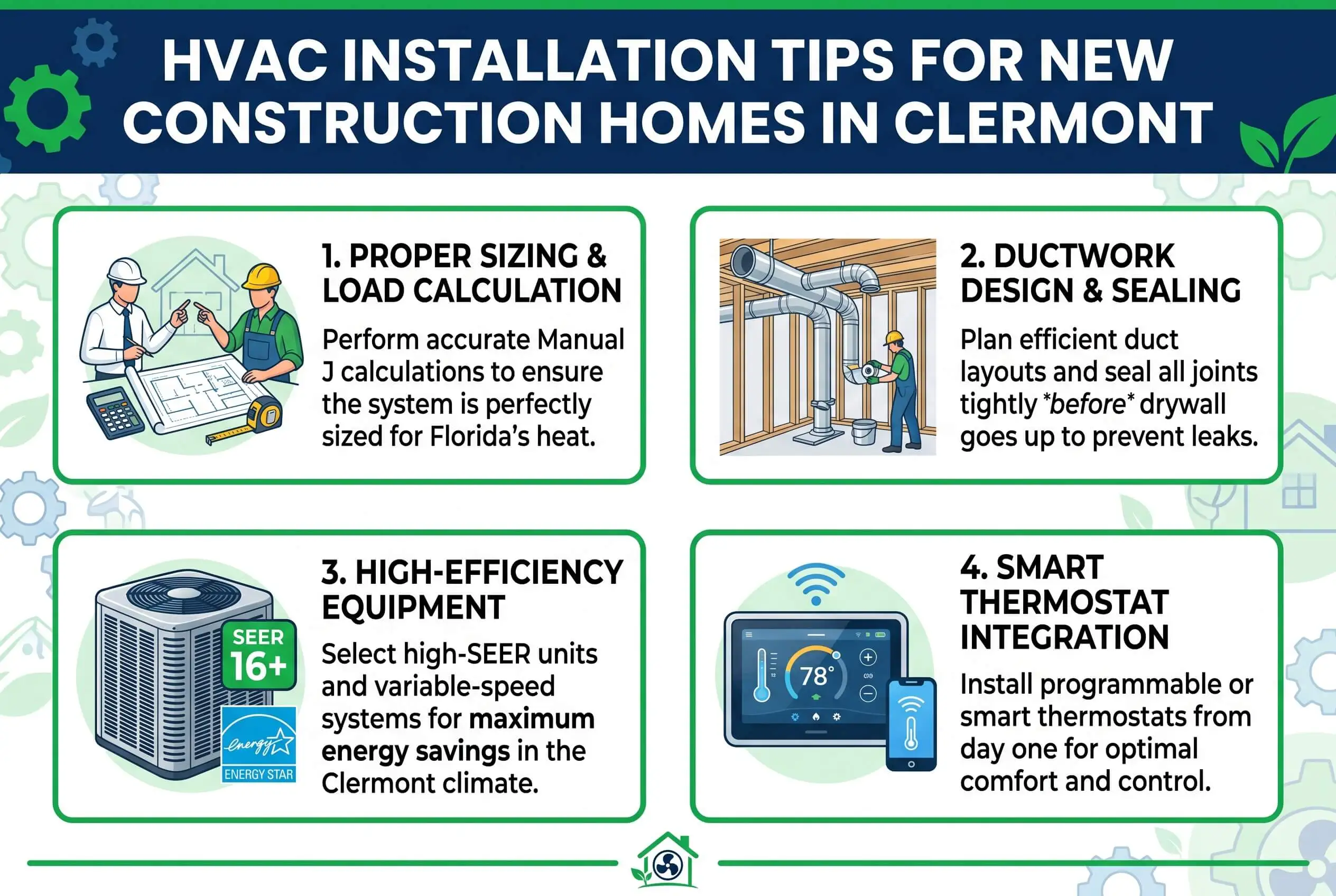
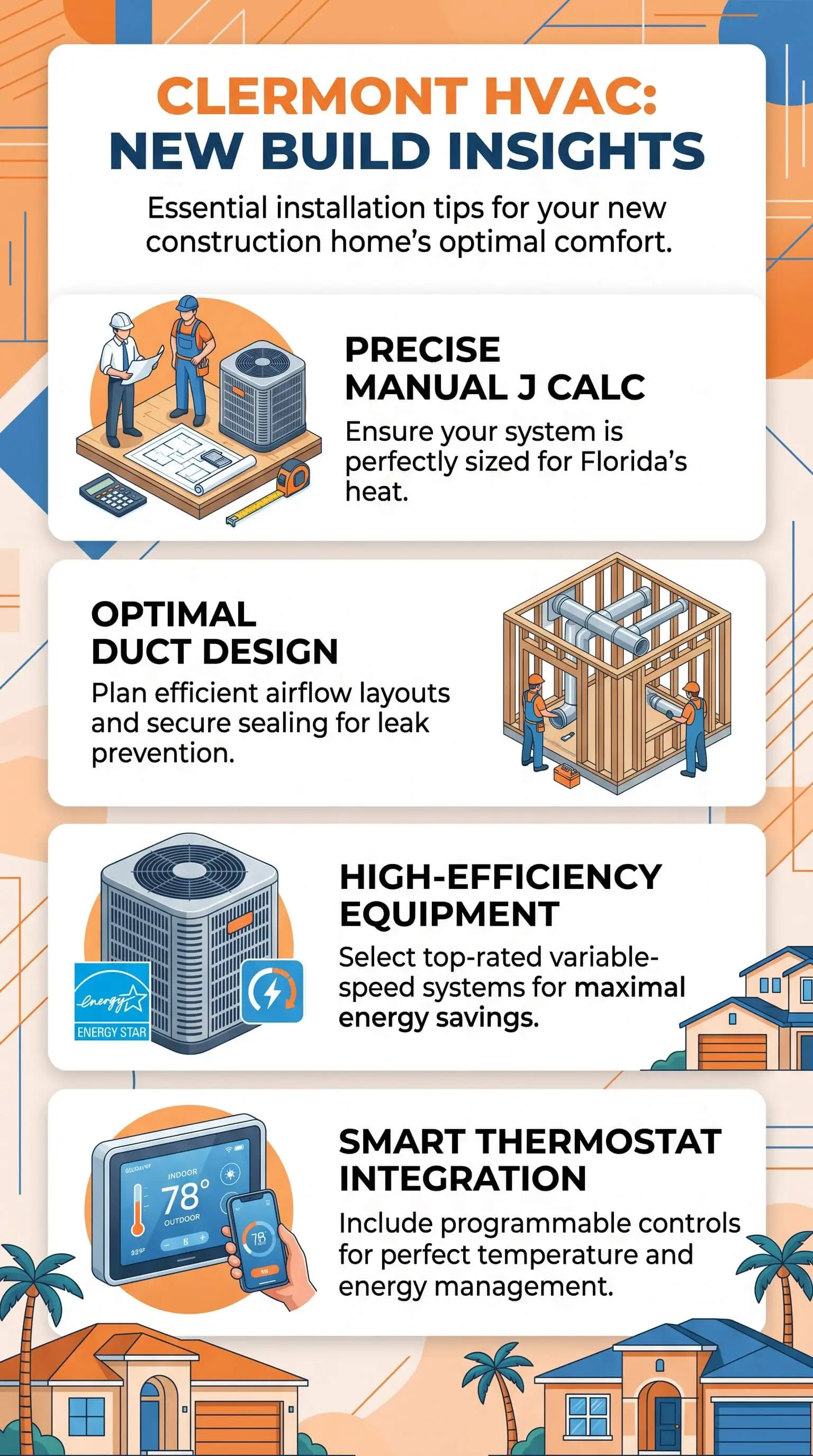
If you're under contract on a new home in Wellness Ridge, Sanctuary, Kings Ridge, or any of the active builds along US-27 and SR-50, planning for a top HVAC system installation near Clermont FL should start before drywall goes up. That early stage gives homeowners the best opportunity to ask the right questions about system sizing, duct layout, airflow, humidity control, and energy efficiency so the finished home delivers stronger comfort, cleaner indoor air, and lower long-term utility costs. The final walkthrough is simply too late to make the most important installation decisions.
TL;DR Quick Answers
What makes a top HVAC system installation near Clermont, FL?
A top HVAC installation in the Clermont area starts with a Manual J load calculation run on the actual home plans, equipment matched to that calculation per Manual S, and ductwork pressure-tested before drywall closes the walls. Anything that skips those three steps is code-minimum work, not top-tier.
What separates a top installer from a code-minimum sub: From what we see across Lake County, a top installer documents the load calculation, equipment selection, and duct test results in writing and hands them to you, while a code-minimum sub installs by floor plan and signs the permit.
How to verify quality before you hire: Pull the contractor's Florida DBPR license at MyFloridaLicense.com to confirm active status, and ask for the AHRI matched-system certification number for the equipment they're proposing.
What documentation you should receive: Manual J report, Manual S equipment selection summary, Manual D duct layout, Florida R405 energy form, AHRI certificate, and duct leakage test results.
Top Takeaways
1. Manual J on the actual plans is the foundation of every other decision. The Florida Building Code requires it, but builders sometimes skip it. Ask for the report by name, on your specific home, before you sign.
2. Bigger is not better in a Clermont climate. Oversized equipment cycles short, leaves humidity high, and shortens compressor life. Variable-capacity systems sized to the actual load handle subtropical humidity better than larger fixed-stage equipment.
3. Duct leakage testing should happen before drywall, not at final walkthrough. Once the walls close, you can't see the connections. Pre-drywall pressure testing is the only reliable point in the build to catch a leaky duct run while you can still fix it affordably.
4. Equipment placement matters more in Clermont attics than in cooler markets. Attic temperatures of 130 to 140 degrees in summer change every assumption about duct insulation R-value and air handler placement. When attic placement is unavoidable, the insulation and sealing standards have to rise to meet the conditions.
5. Keep the documentation folder. The Manual J report, the AHRI certificate, the duct leakage test results, and the permit close-out belong with your closing papers, both for the next service technician and for the next buyer if you ever sell the home.
Why Manual J Load Calculations Are Non-Negotiable in Clermont
The Florida Building Code, Mechanical 8th Edition (2023) requires a Manual J load calculation for every new residential HVAC installation, and the calculation has to be specific to your home rather than copied from another house in the same plan or pulled off a spec sheet. The actual orientation, the actual window package, the actual insulation values, and the actual envelope tightness all feed the calculation, and the output determines what equipment gets selected.
Two homes in the same Clermont subdivision can carry materially different loads. We've inspected 2,400-square-foot homes in Bella Collina where the south-facing units were calculated to a 3-ton system while their north-facing neighbors across the street, same builder, same plan, came in closer to 3.5. Lake-facing homes near Lake Hiawatha behave differently from interior lots because of how moisture moves at sundown. None of that shows up in a square-footage rule of thumb. It all shows up in a properly run Manual J.
What to ask your builder, in writing:
A copy of the Manual J load calculation report for your specific plan
The Manual S equipment selection summary that shows the chosen system matches the calculated load
The Manual D duct design layout
The Florida R405 energy compliance form
If the builder can't produce these or hesitates when you ask, that's the answer to the question.
How to Avoid the Most Common New-Construction Installation Mistakes
Oversizing is the most common mistake we see, and it's worth understanding the mechanism behind it. In IECC Climate Zone 2A, which covers Clermont and most of the Florida peninsula, latent load (the moisture the system has to remove) matters as much as sensible cooling (the temperature drop). Longer run times pull moisture out of the air. Short cycles don't. An oversized system handles temperature beautifully and leaves humidity sitting at 60% or higher, which is why a 72-degree house can still feel sticky.
Duct leakage in attic runs is the second mistake, and it's harder to catch after the fact. Central Florida attic temperatures run 130 to 140 degrees on a normal summer afternoon, and conditioned air leaking from an unsealed flex-duct connection into that environment doesn't just waste energy. It pulls hot, humid attic air back into the system through return-side leaks, and the equipment ends up working under load it was never sized to handle. Pressure-testing the ducts before drywall is the only reliable way to find these leaks while you can still fix them affordably.
Refrigerant charge errors at startup, neglected ASHRAE 62.2 mechanical ventilation in tight envelopes, and air handlers placed in unconditioned attic space without adequate insulation round out the list. Each of these is fixable, but only if someone knows to look for them before the keys change hands.
Equipment Selection for a Clermont New Home
Tight new-construction envelopes change the equipment math. The post-2005 master-planned communities going up along US-27 and SR-50 are built to a much tighter standard than the 1990s and early-2000s housing stock closer to Historic Downtown Clermont. That tightness lowers sensible cooling loads but holds humidity in the house longer, which raises the latent load. Variable-capacity inverter-driven systems handle that profile better than fixed-stage equipment because they can run at lower output for longer periods, and longer run time is what actually pulls moisture out of the air.
For the Southeast region, the federal minimum for split systems under 45,000 Btu/h is currently SEER2 14.3. Most Clermont builders default to that minimum, and there's nothing wrong with it as a baseline. The decision worth making is whether the upgrade to a variable-capacity system at a higher SEER2 rating pays back over the life of the home. In a climate that runs cooling loads nine to ten months a year, the math usually favors the upgrade.
The 2025 R-454B refrigerant transition matters here too, especially when working with a professional HVAC installation service. Systems installed in 2025 and 2026 are using R-454B in place of R-410A, which affects future service availability for older R-410A equipment. We always ask buyers to verify two things on the AHRI certificate: that the indoor and outdoor units are listed as a matched pair, and that the refrigerant and capacity match the Manual S selection.
Working With Your Builder: Questions to Ask Before Closing
The builder's standard HVAC allowance covers a code-minimum installation by their preferred sub. That's not necessarily a bad system, but it almost never matches your specific lot, orientation, and household. We tell every new construction buyer in Clermont to walk into the builder conversation with five questions:
Will you provide the Manual J load calculation, Manual S equipment selection summary, and Manual D duct layout for my specific home?
What duct leakage testing protocol does your sub use, and at what stage of construction?
Is the air handler placed inside conditioned space, or in the attic?
What is the AHRI matched-system certification number for the equipment you're proposing?
What is the Florida DBPR contractor license number for the HVAC sub doing the installation?
The Florida DBPR license question is the easiest one to verify. Anyone can pull up a contractor at MyFloridaLicense.com and confirm they're licensed and insured. Unlicensed sub-tier work shows up more often in budget builds than people realize.
At closing, the home should come with a folder containing the Manual J report, the Manual S selection summary, the Manual D duct layout, the Florida R405 energy compliance form, the AHRI certificate, the duct leakage test results, and the permit close-out documentation. A top rated professional HVAC installation service will make sure this documentation is complete and properly organized for the homeowner. Keep that folder. It's the documentation any future service technician will need, and it's what you hand to a buyer if you ever sell the home.
“Most of the homes we walk in Wellness Ridge and along the US-27 corridor were sized at four tons because the floor plan was 2,400 square feet. The actual Manual J on those homes runs closer to three tons, sometimes three and a half. The four-ton system cycles for eight minutes, drops the temperature, shuts off, and the humidity climbs right back up. By year four or five, we're replacing compressors that should have lasted twelve to fifteen years. It's a sizing problem, not an equipment problem.”
7 Essential Resources
Each link below is a primary live source. Use them to verify what you read on this page and to take the conversation deeper with your builder.
Florida Building Code Online — the official portal for the Florida Building Code, including the Mechanical 8th Edition (2023).
Florida DBPR Contractor License Verification — confirm any HVAC contractor's license status, qualifying agent, and insurance.
ACCA Manual J — Residential Load Calculation — the ANSI-recognized national standard for HVAC equipment sizing in single-family homes.
ENERGY STAR HVAC Quality Installation — homeowner-facing checklist for what a properly installed HVAC system actually requires.
AHRI Directory of Certified Product Performance — verify that the indoor and outdoor units of your system are a certified matched pair.
U.S. Department of Energy — HVAC, Refrigeration, and Water Heating — federal research on HVAC efficiency, installation quality, and equipment standards.
Heating, Ventilation, and Air Conditioning — Wikipedia — background reference on HVAC system fundamentals, terminology, and standards.
These trusted resources give homeowners valuable guidance for planning a top HVAC installation by explaining proper system sizing, energy-efficient design, certified equipment matching, Florida code compliance, and contractor verification — all of which help create a more comfortable, efficient, and reliable HVAC system for long-term performance in Clermont homes.
3 Statistics
All three figures below come from primary live .gov sources with original research methodology cited at the link.
Heating and cooling buildings accounts for approximately 35% of all energy consumption in the United States, the largest share attributable to any single end use. Source: U.S. Department of Energy.
Improper HVAC installation can increase household energy use for space heating and cooling by approximately 30% over what it should be. Common faults include leaky ducts, improper refrigerant charge, oversizing of systems, and restricted airflow. Source: NIST Technical Note 1848 (Domanski, Henderson, Payne, 2014).
Duct leakage and low duct insulation levels cause an average loss of 37% in overall cooling efficiency. Air conditioners installed with these faults frequently also have insufficient airflow across the indoor coils and refrigerant undercharging from improper installation procedures. Source: U.S. Department of Energy, Office of Energy Efficiency and Renewable Energy.
Final Thoughts and Opinion
Getting the HVAC right in a new construction Clermont home is a decision that compounds. We can point to systems we installed in Lake County a decade ago that are still running with their original compressors today, and we can point to systems installed by rule of thumb in 2018 that started failing before the warranty paperwork was even filed away. The difference between those two outcomes has almost nothing to do with equipment brand or price. It comes down to whether someone ran a real Manual J on the actual plans, sized the equipment to that calculation, sealed and tested the ductwork before drywall went up, and verified the refrigerant charge at startup.
The new construction market in Lake County has improved over the last decade. The builders working in Clermont today are using tighter envelopes and better equipment than they were ten years ago, and that's genuinely better for homeowners. The gap is in the documentation and in understanding how regular HVAC maintenance supports long-term system performance. Buyers who ask for the Manual J report, the Manual S summary, the AHRI certificate, and the duct test results, and who actually read them, get materially better systems than buyers who don't. That's the honest answer to what makes the difference.
Frequently Asked Questions
Does Florida require a Manual J load calculation for new construction HVAC installation?
Yes. The Florida Building Code, Mechanical 8th Edition (2023) requires HVAC equipment to be sized using ACCA Manual J or equivalent procedures, and the calculation has to be specific to your building rather than generic or square-footage based. Most local jurisdictions, including Lake County and the City of Clermont, require the Manual J report as part of the permit submittal package. If your builder cannot produce one for your specific plan, what you're looking at is a code compliance problem, which is a more serious conversation than a routine service question.
How much does HVAC installation cost in a new construction Clermont, FL home?
Pricing varies based on system size, equipment tier, ductwork complexity, and whether the home is on a slab or has a chase that simplifies the duct run. Builder allowances cover code-minimum equipment, and upgrades to higher-SEER2 variable-capacity systems run higher. We recommend getting itemized cost details from the builder rather than accepting a lump-sum allowance, so you know exactly what you're paying for.
What size HVAC system does a 2,000 square foot Clermont new-construction home need?
Honest answer: square footage is a poor predictor on its own. A 2,000-square-foot home in Wellness Ridge with tight envelope construction, ENERGY STAR-rated windows, and good attic insulation might calculate to a 2.5-ton system on its Manual J. The same square footage in older Clermont stock with leaky ductwork and minimal insulation can calculate to 3.5 tons. The square footage tells us almost nothing on its own, while the Manual J does the actual math.
Should I use the builder's standard HVAC allowance or upgrade?
The standard allowance covers a code-minimum installation, which works, but it almost never matches your specific lot, orientation, and household. The decision worth making is whether the upgrade to a variable-capacity system pays back over the life of the home. In a climate that runs cooling load nine to ten months a year, the longer run times of a variable-capacity system handle humidity better, and the energy savings typically recover the upgrade cost within seven to ten years.
What is the difference between SEER2 and HSPF2, and which matters more in Clermont's climate?
SEER2 measures cooling efficiency, and HSPF2 measures heating efficiency for heat pumps. Both replaced the older SEER and HSPF metrics in 2023, with revised test procedures that better reflect real-world conditions like ductwork resistance and filter restrictions. In Clermont, cooling efficiency dominates the energy bill conversation, so SEER2 is the rating that matters most for the operating cost calculation. HSPF2 still matters for those few weeks each year when temperatures drop into the 30s and the heat pump kicks into reverse cycle.
How do I verify my HVAC contractor is licensed in Florida?
Use the Florida DBPR license lookup at MyFloridaLicense.com. Enter the contractor's name or license number and confirm the license is active, the qualifying agent is current, and the company carries the required insurance. Florida HVAC work requires a state-certified or state-registered license per Florida Statute Chapter 489. Anyone performing HVAC installation without one is operating outside the law, regardless of how the invoice reads.
How long does HVAC installation take during new home construction?
The work happens in two phases. The rough-in (running ductwork, setting the air handler location, placing the condenser pad) happens before drywall, typically over two to three days for a single-family home. The trim-out, where the equipment is set, connected, charged, and started, happens after drywall and finish work, usually over one to two days. Pressure testing and duct leakage verification add a day. Total active labor is usually four to seven days spread across the build schedule.
Get the HVAC Right Before Drywall Closes in Your Clermont Home
Getting the HVAC right before drywall closes is the most cost-effective decision a Clermont new-construction buyer can make. Schedule a pre-drywall walkthrough and we'll sit down with the Manual J, the equipment selection summary, and the duct layout to make sure your system is sized for the home you're actually getting, not just the floor plan.
