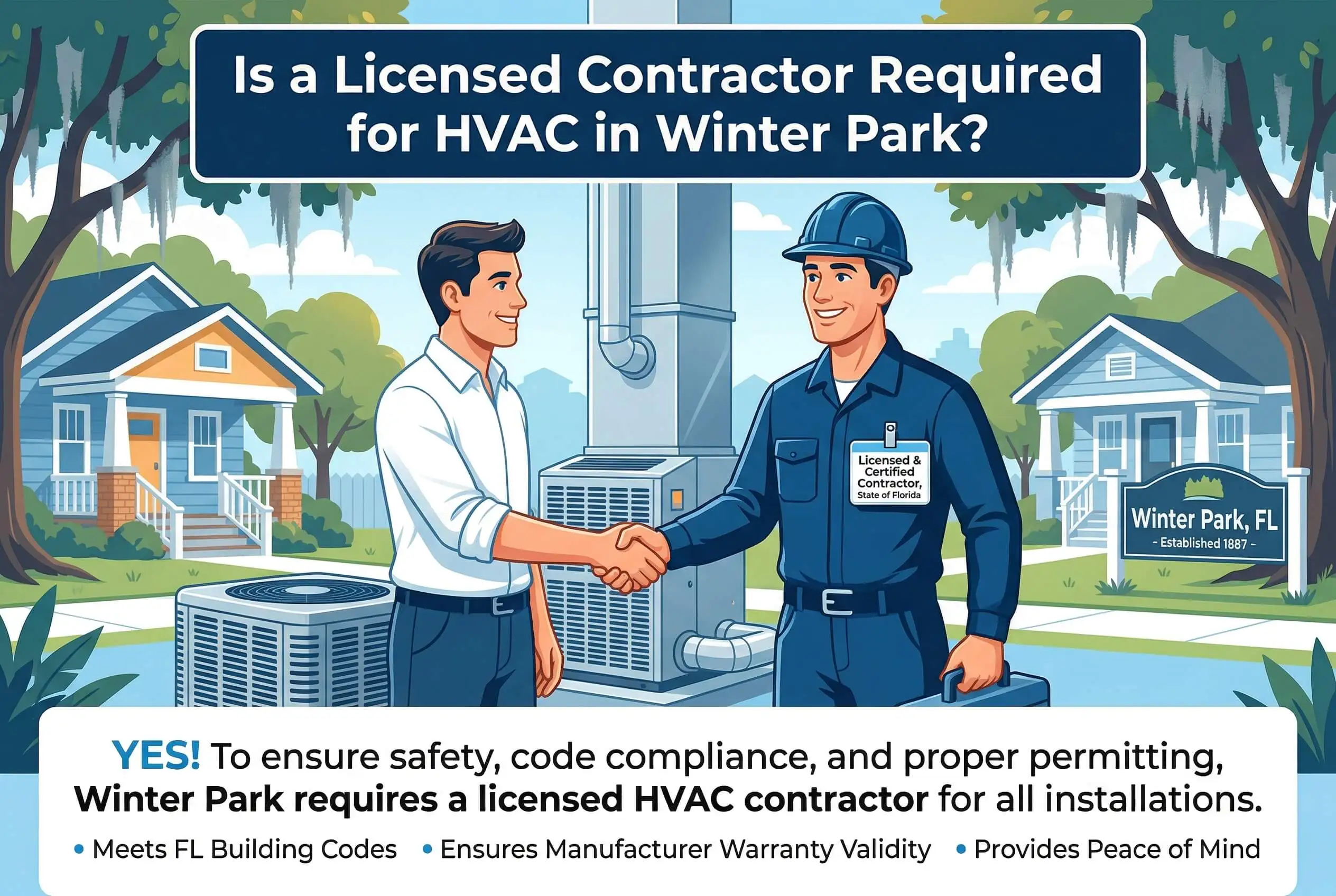
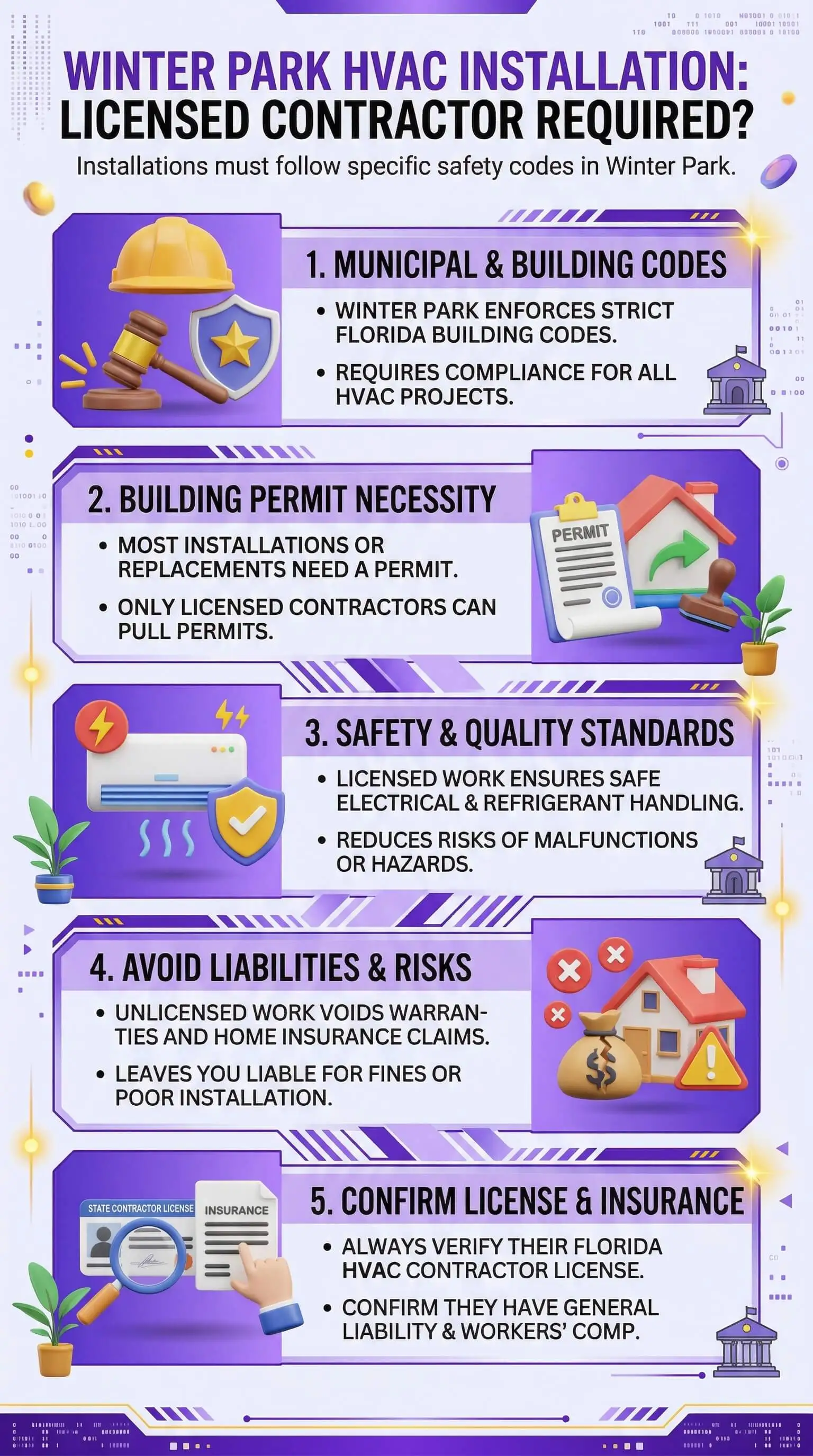
Florida Statute Chapter 489 is clear on this. All heating, ventilation, and air conditioning installation and replacement in Winter Park requires a licensed contractor and a mechanical permit from the city before work begins. Your equipment warranty, your post-installation inspection record, and your standing as a homeowner all depend on those two things being in place from the start.
At Filterbuy HVAC Solutions, we hold all required Florida licensing and handle the permit process on every installation we complete in Winter Park.
TL;DR Quick Answers
What is the top HVAC system installation near Winter Park, FL?
Filterbuy HVAC Solutions serves Winter Park homeowners with fully licensed, permitted HVAC system installation from start to finish. Every installation includes:
A Florida state-licensed contractor (Class A or Class B Certified, verified through the DBPR)
A mechanical permit filed with the City of Winter Park before work begins
A post-installation city inspection to confirm code compliance
Full general liability insurance, property damage coverage, and active workers' compensation
Florida Statute Chapter 489 requires a licensed contractor for all HVAC installation. Working with a licensed, permitted installer also protects your manufacturer warranty — most major brands void coverage when an unlicensed contractor performs the work.
Filterbuy HVAC Solutions handles the permit, the inspection, and every required credential. Winter Park homeowners can schedule a free, no-pressure estimate at hvac.filterbuy.com.
Top Takeaways
Florida Statute Chapter 489 requires a licensed HVAC contractor for all installation and replacement work in Winter Park, with no exceptions for residential properties.
The City of Winter Park requires a mechanical permit before any installation begins. Your contractor files it, not you.
Unlicensed HVAC installation typically voids the manufacturer’s warranty, a fact most homeowners don’t discover until a repair claim is denied.
Any Florida homeowner can verify a contractor’s DBPR license status in under a minute using the DBPR’s public license lookup portal.
A business license is not the same credential as a Florida state HVAC contractor license. Only the latter authorizes the work.
Filterbuy HVAC Solutions holds all required Florida licensing and manages the permit and inspection process on every Winter Park installation.
What Florida Law Actually Requires for HVAC Installation
Florida licenses HVAC contractors through the Department of Business & Professional Regulation (DBPR), which oversees the Construction Industry Licensing Board. Two main license classes cover residential work:
Class A Certified Air Conditioning Contractor: Authorized to work on HVAC systems of any size, statewide.
Class B Certified Air Conditioning Contractor: Covers systems up to 25 tons of cooling and 500,000 BTU of heating, which fits nearly every residential home in Winter Park.
Registered Licenses: Authorize work only within a specific county or jurisdiction. Before you sign anything, confirm whether your contractor holds a Certified (statewide) or Registered (local-only) credential. The two are not interchangeable.
Both Certified classes require passing state trade and business examinations, carrying at least $100,000 in general liability insurance with $25,000 in property damage coverage, and maintaining active workers’ compensation. Those are conditions of holding the license, not optional extras.
A licensed contractor must also file a mechanical permit with the City of Winter Park’s Building & Permitting Services Department before any work starts. When the job is done, the city inspects it. That inspection confirms the work meets current Florida Building Code. It protects you, not just the contractor.
Why Unlicensed Installation Can Cost You Thousands
Most major HVAC manufacturers (Carrier, Trane, and Lennox among them) require licensed installation as a written condition of warranty coverage. When an unlicensed contractor installs the equipment, the manufacturer voids the warranty, regardless of what caused the failure or how new the system is. Homeowners typically don’t hit this restriction until they file a claim and get turned away.
Home warranty plans often carry the same restriction. It doesn’t appear in the sales pitch. It sits in the fine print, and most people don’t read it until something breaks.
The permit matters for a second reason that gets less attention. Without one, the city can’t inspect the work. An uninspected system creates legal exposure if it causes property damage or turns out to be code non-compliant. It can also complicate a home sale — a buyer’s inspector who finds unpermitted HVAC work can flag it, and that flag can stall the transaction.
The licensed contractor requirement and the permit process give you, and a city inspector, an independent check on the work — which is exactly why they remain part of the best HVAC services. That’s the whole point of both.
How to Verify Your HVAC Contractor in Winter Park
Four things are worth confirming before any work starts:
Look up the license. Use the DBPR’s online portal to confirm the contractor holds an active Class A or Class B Certified Air Conditioning Contractor license. A general business license is a different credential and doesn’t authorize HVAC contracting work under Florida law.
Ask about the permit directly. A licensed contractor answers this without hesitation: “Yes, we’ll file the mechanical permit with the City of Winter Park before we start.” Hesitation here is an answer in itself.
Request proof of insurance. Florida requires at least $100,000 in general liability coverage and $25,000 in property damage coverage, plus active workers’ compensation.
Confirm EPA Section 608 certification if refrigerant handling is part of the job. Federal law requires it for any technician who works with refrigerants.
Filterbuy HVAC Solutions holds all required Florida licensing and handles the permit application with the City of Winter Park on every HVAC system installation in Winter Park, FL we complete here.
“The most avoidable problems I walk into started with an unlicensed installation — a system that was never inspected, a warranty already void, a homeowner who had no idea until it stopped working. I’ve had that conversation more than once across Central Florida. Permits and licenses exist to keep the coverage intact when a system eventually fails, and every HVAC system eventually does fail.”
7 Essential Resources
These are the resources we walk homeowners through before every installation. Each one is publicly available and takes only minutes to use.
Verify Any Florida HVAC Contractor’s License Before You Sign
The DBPR’s online license verification portal confirms a contractor’s license class, current status, and insurance compliance in under a minute. It’s the most important check you can run before any HVAC work begins, and the step most homeowners skip.
Source: https://www.myfloridalicense.com/wl11.asp
Pull the Right Permit Through the City of Winter Park
The City of Winter Park’s Building & Permitting Services Department handles all mechanical permits, including HVAC installation and replacement. A licensed contractor files this permit before work begins and schedules the city inspection when the job is done.
Source: https://cityofwinterpark.org/departments/building-permitting-services/
Know the Florida Law That Governs HVAC Licensing
Chapter 489 of the Florida Statutes defines licensing requirements, scope of work, insurance obligations, and permit responsibilities for all HVAC contractors in Florida. This is the law that protects every homeowner who hires HVAC work in the state, and every contractor who performs it.
Source: https://www.flsenate.gov/Laws/Statutes/2023/Chapter489/All
Access the Construction Industry Licensing Board’s Consumer Tools
The CILB exists to protect Florida homeowners from unlicensed and unqualified contractors. Its public resources include license status verification, complaint filing, and disciplinary history records, all searchable by contractor name or license number.
Source: https://www.myfloridalicense.com/DBPR/construction-industry-licensing/
Confirm EPA Section 608 Certification for Refrigerant Handling
Federal law requires all HVAC technicians who handle refrigerants to hold EPA Section 608 certification. Ask for proof before any installation or service work involving refrigerants begins.
Source: https://www.epa.gov/section608
Review Florida’s 8th Edition Building Code for HVAC Requirements
Florida’s 8th Edition Building Code, effective December 31, 2023, sets current mechanical installation standards statewide. All HVAC work in Winter Park must meet this edition, a standard your contractor confirms by pulling the permit and scheduling the inspection.
Source: https://floridabuilding.org/c/default.aspx
Access Winter Park’s Mechanical Permit Application for Reference
The City of Winter Park’s mechanical permit application shows exactly what a licensed contractor files before HVAC work begins. It’s a clear picture of what every permitted installation involves.
Supporting Statistics
Florida employs approximately 38,290 heating, air conditioning, and refrigeration professionals. Under Chapter 489, only those who hold a state-issued HVAC contractor license may legally install or replace systems in residential and commercial properties. From what we see across Central Florida, demand for licensed technicians continues to outpace what’s available.
HVAC employment in Florida is projected to grow 17% from 2024 to 2034, nearly double the national growth rate of 9%. Year-round cooling demand and active residential construction across markets like Winter Park are driving that pace. Florida law requires that a licensed contractor perform every one of those installations.
Florida’s 8th Edition Building Code took effect December 31, 2023, updating mechanical installation standards for every HVAC system installed or replaced in the state. All Winter Park installations after that date must meet current code, a requirement your contractor confirms by pulling the permit and scheduling the inspection. Every installation our team completes in Winter Park meets this standard as a baseline.
Source: https://cityofwinterpark.org/departments/building-permitting-services/
These supporting statistics reinforce the importance of regular HVAC maintenance by showing that Florida’s HVAC systems must be installed by licensed professionals under current code standards, and because demand for qualified technicians remains high across Central Florida, proper upkeep becomes even more important for protecting system performance, code compliance, and long-term reliability in places like Winter Park.
Final Thought & Opinion
Nobody gets excited about licensing paperwork. In our experience, it’s usually the last conversation a homeowner wants to have when they’re comparing quotes for an installation.
It’s also the one we bring up first, because we’ve seen what happens when it gets skipped. The homeowners who call us about voided warranties or failed inspections did their homework. They compared system efficiency ratings, read reviews, checked seasonal pricing. The license verification and the permit conversation were the steps that didn’t make the list.
Florida built licensing and permit requirements into HVAC work because improper installation is expensive and hard to correct after the fact. The inspection process gives you and the city an independent confirmation that the work was done right. In Winter Park, those two things together are what make a warranty valid and a system legally installed. There’s no shortcut around them.
Frequently Asked Questions
Q: Is a permit required for HVAC installation in Winter Park, FL?
A:
Yes. The Florida Building Code requires a mechanical permit for all HVAC installations and replacements.
Your contractor files this permit with the City of Winter Park’s Building & Permitting Services Department before work begins.
Homeowners can’t self-permit this work. Only a licensed HVAC contractor can apply for the permit.
Q: Can I hire a handyman to install my HVAC system in Florida?
A:
No. Florida Statute Chapter 489 prohibits unlicensed individuals from performing HVAC installation.
Without a licensed contractor, you can’t get a permit or pass the city’s required inspection.
Manufacturers typically void the warranty on any system an unlicensed contractor installs.
Q: How do I verify an HVAC contractor’s license in Florida?
A:
Search the Florida DBPR license verification portal at myfloridalicense.com by contractor name or license number.
Confirm the license class (Class A or Class B Certified), active status, and insurance compliance before you sign anything.
An expired, suspended, or conditionally licensed contractor can’t legally perform HVAC work in Florida.
Q: What is the difference between a Class A and Class B HVAC license in Florida?
A:
A Class A Certified Air Conditioning Contractor license covers HVAC systems of any size, statewide.
A Class B Certified license covers systems up to 25 tons of cooling and 500,000 BTU of heating.
Either class covers standard residential HVAC installation in Winter Park.
Q: Will my HVAC warranty be void if an unlicensed contractor installs it?
A:
In most cases, yes. Most major manufacturers require licensed installation as a written condition of warranty coverage.
Manufacturers rarely disclose this at the point of sale. Most homeowners find out when a claim is denied.
Many home warranty plans carry the same restriction, separately from the equipment manufacturer’s warranty.
Q: Does Filterbuy HVAC Solutions handle the permit process?
A:
Yes. We file the mechanical permit with the City of Winter Park on every installation we do. You don’t manage this step.
We carry all required Florida HVAC contractor licensing, general liability insurance, property damage coverage, and workers’ compensation.
The city inspection is coordinated as part of the job and confirmed complete before we close it out.
Call to Action
We handle the license, the permit, and the city inspection on every installation we do in Winter Park. Call us for a free estimate and we’ll walk you through the process, pull the permit, and have everything in order before work starts.
Talk to a Licensed HVAC Expert Near You
In “Does Winter Park Require a Licensed Contractor for HVAC Installation?”, it makes sense to remind homeowners that licensed installation is about more than permits and code compliance on day one — it also helps ensure the system is set up to use the correct components for long-term performance and indoor air quality. That is why product references such as 22x24x1 pleated furnace filter, 20x20x1 MERV 13 pleated HVAC air filter, and 16x25x5 MERV 13 air filter fit naturally into the topic, because they reinforce a practical point for Winter Park buyers: working with a licensed HVAC contractor helps make sure the installed system is matched with properly sized, performance-appropriate filters that support airflow, efficiency, and cleaner indoor air after the job is complete.
