Don't take your indoor air for granted, especially in a Buffalo house that stays shut tight from the first lake-effect storm until spring! Radon, lead dust, carbon monoxide, and basement moisture all build up quietly when the windows stay closed for months, and you can't see any of them.
A professional air test earns its fee when your home gives you a specific reason to order one. In this city, older housing and the soil gas under basement floors supply most of those reasons, and summer smoke from Canadian wildfires has added another.
Here's something that might surprise you: two homes twenty minutes apart in Erie County can face completely different risks. Radon rarely turns up in City of Buffalo basements, yet it shows up in more than half the basements in several Southtowns communities. Which test you need, and whether you need one at all, comes down to where you live, the air quality Buffalo NY conditions in your area, and what you've noticed inside.
TL;DR Quick Answers
air quality Buffalo NY
Buffalo’s outdoor air usually sits in the Good to Moderate range on the EPA’s Air Quality Index, and fine particles (PM2.5) and ground-level ozone drive most readings. Canadian wildfire smoke brings the worst days. Don’t take your indoor air for granted, though, because those particles slip inside and outdoor maps can’t detect radon.
Check Today’s Reading: The live AQI map and AirNow both pull data from New York DEC monitors in Erie County.
Know the Line: Above 100, people with asthma, COPD, or heart disease, along with kids and adults over 65, should limit time outdoors. Above 150, everyone should cut back.
Plan for Smoke Season: Summer wildfire smoke from Canada has caused Buffalo’s highest readings in recent years.
Protect the Air Inside: On high-AQI days, close the windows, switch the thermostat fan to On, and run a MERV 8 filter or a portable HEPA air cleaner.
Test What Maps Miss: Outdoor AQI doesn’t measure radon or lead dust, so test for those inside your home.
Top Takeaways
Test for a reason. Symptoms, water damage, renovation, fuel-burning appliances, and home sales are what justify bringing in a professional.
Start with radon. Every Erie County home should test, and the risk swings sharply between the city and the Southtowns.
Respect the lead in older homes. Dust from pre-1978 paint calls for a certified inspector.
Look outside before you blame the house. On high-AQI days, smoke and traffic particles that drift indoors can push your readings up all on their own.
Hire licensed, separate mold pros. New York won't let the same person assess and remediate one property.
Signs Your Buffalo Home Needs an Indoor Air Quality Test
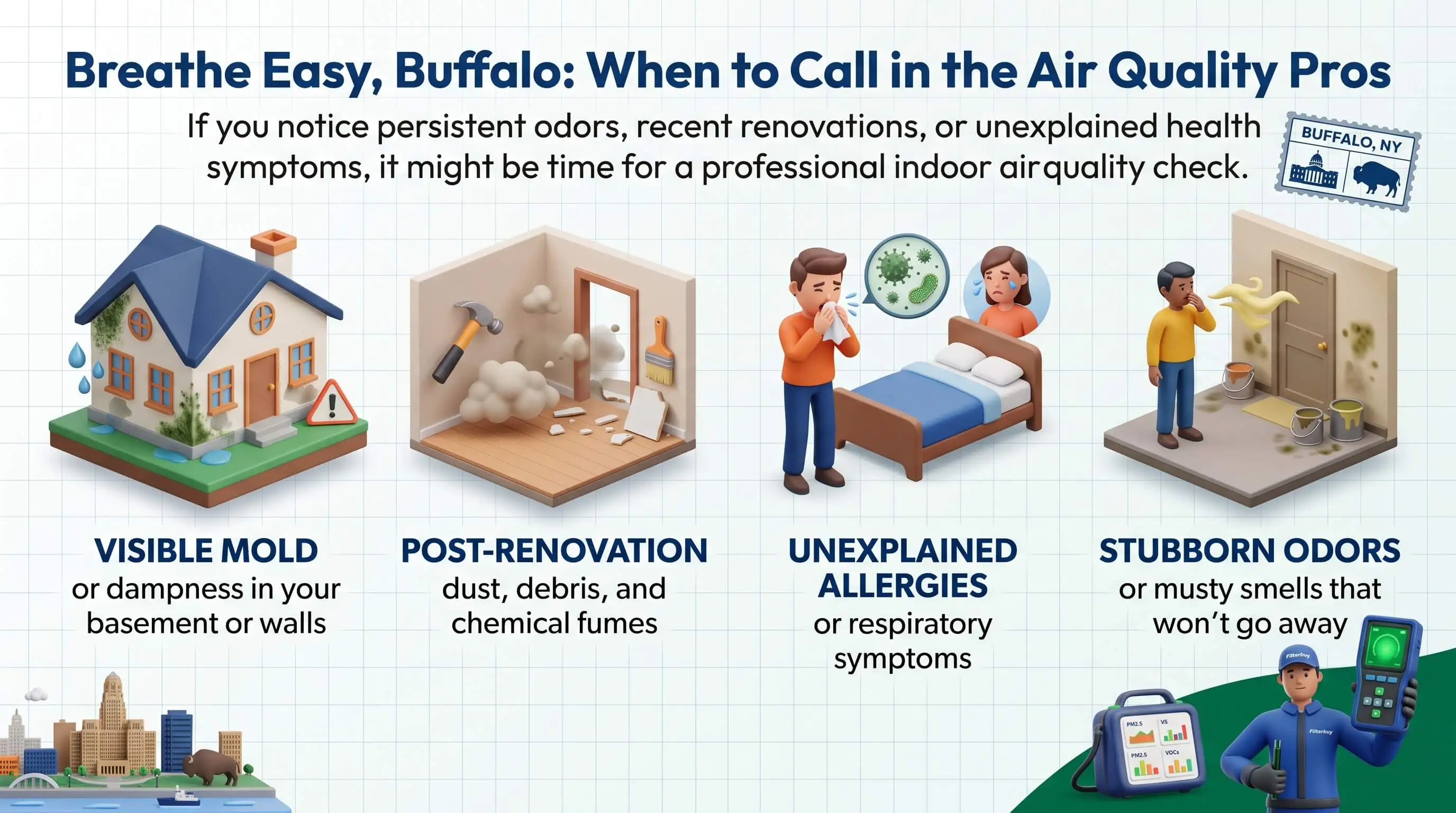
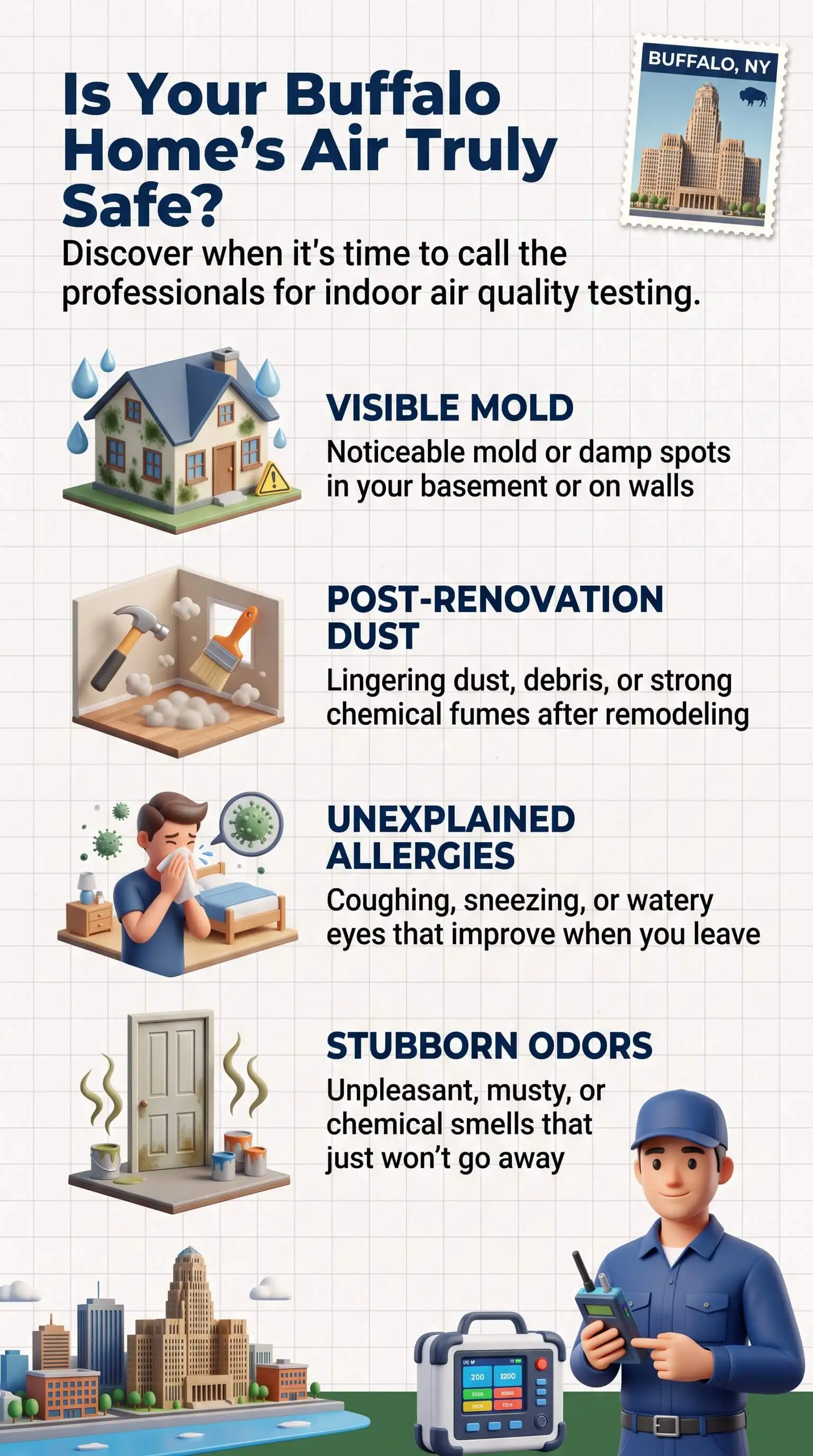
A test pays off when it answers a question you already have. We'd take any of these signals seriously:
Symptoms that fade when you leave. Headaches, a cough that lingers, or itchy eyes that clear up at work or on vacation usually trace back to the house.
A musty basement or a history of water. Past flooding, a damp foundation wall, and condensation on the windows all give mold what it needs.
Renovation in an older home. Sanding, demolition, or new windows in a pre-1978 house can kick up lead dust.
Anything that burns fuel. Gas furnaces, older boilers, water heaters, and attached garages can all release carbon monoxide.
New people under your roof. A newborn, an aging parent, or a fresh asthma diagnosis raises the stakes on air you've lived with for years.
A home sale. Buying or selling is the natural time to test, and radon belongs at the top of that list.
The Hidden Risks Behind Buffalo's Older Homes
Buffalo has some of the oldest housing of any large U.S. city. We love the character, but those houses hide four risks, and we'd check them in this order.
Radon
Radon is a radioactive gas with no smell and no color. It seeps up from the soil through foundation cracks, and Erie County ranks among New York's high-risk radon counties. Your town makes a big difference. State estimates place the City of Buffalo near the bottom for elevated basements and put Marilla, Concord, Sardinia, and Wales near the top. Winter makes it worse, since warm air rising through the house pulls soil gas in from underneath. If you run only one test this year, make it this one.
Lead Dust
Paint applied before 1978 can contain lead, though intact paint poses little risk by itself. Trouble starts at friction points like old windows and doors, or whenever someone sands or demolishes, because that's when paint breaks down into fine dust that settles on the floors and sills where kids crawl and play. Leave this one to a certified lead inspector or risk assessor. A home kit won't cut it.
Carbon Monoxide
Buffalo winters keep furnaces, boilers, and water heaters working hard for months inside closed houses. Start with working CO alarms. Call a professional for a combustion check if an alarm goes off, a burner flame burns yellow instead of blue, or headaches seem to cluster on the coldest days.
Moisture and Mold
Stone and block basements, lake-effect snowmelt, and muggy summers keep plenty of Buffalo foundations damp. Mold can't grow without moisture. So a humidity reading and a flashlight sweep of the basement usually tell you more, at first, than a mold air sample will.
How Outdoor Air Quality in Buffalo Affects the Air Inside
Fine particles from expressway traffic, the Peace Bridge truck plaza, and wildfire smoke slip in around windows and doors, then linger in indoor air for hours. In July 2026, Canadian smoke pushed Buffalo's readings into the Very Unhealthy range.
So before you blame the house, look outside. The Air Quality Index scores outdoor air from 0 to 500, and once readings pass 100, people in sensitive groups should limit their exposure. When an indoor monitor spikes on a high-AQI day, the source is probably outdoors. Closing up and filtering will do more good than booking a tester.
What a Professional Test Covers and When DIY Is Enough
You can handle part of this yourself. A short-term radon kit, CO alarms on every level and outside sleeping areas, and an inexpensive humidity monitor for the basement are all do-it-yourself jobs.
Bring in a professional for:
Mold after water damage, or a musty smell that won't quit
Lead dust sampling in a pre-1978 home, especially with young children around
Symptoms nobody can trace to a cause
Radon results at or above the action level, which call for a certified mitigation contractor
New York has one mold rule worth knowing before you hire anyone. Mold assessors and remediators need state licenses, and the same person can't assess and remediate the same property, so whoever diagnoses the problem never profits on the fix. Ask for the license number and check it with the state Department of Labor before you book.
What to Do if Your Home Has No Ductwork
Plenty of Buffalo homes heat with boilers and radiators, which leaves no central filter to upgrade. A forced-air HVAC system circulates air through ductwork and filters, while boiler-heated homes need separate solutions to manage indoor pollutants. In those houses, source control and room-level cleaning carry the load. Run the kitchen and bath exhaust fans, keep basement humidity down with a dehumidifier, and put a portable HEPA air cleaner sized for the space in your bedroom.
Pro Tip: In a forced-air home, a well-fitted filter changed on schedule does more than most people expect, and the way the system went in matters too. We covered that in our look at how HVAC installation affects indoor air quality.
"Every winter we see the same thing in Buffalo basements. A January reading taken with the house shut tight often runs higher than the same basement in July, because warm air escaping through the attic pulls soil gas up through the slab. I tell homeowners to test during the heating season with the windows closed, since that worst-case number is the one their family actually breathes."
7 Essential Resources
Live Air Quality in Buffalo, NY Map: Today's outdoor AQI, the pollutant behind it, and what to do indoors on smoke days.
NYSDOH Radon Program: Order a $12.25 state test kit and learn the action levels and retest schedule.
LeadSAFE Erie County: Look up whether your home predates 1978, and find county lead programs and tap water testing.
HUD: About Lead-Based Paint: Federal guidance on lead hazards in older homes.
American Lung Association: Mold and Dampness: Moisture control steps, plus why indoor humidity should stay below 50 percent.
CPSC Carbon Monoxide Information Center: Where CO alarms belong and how to keep them working.
AirNow: Using AirNow During Wildfires: A guide to the Fire and Smoke Map for the days smoke drifts into Western New York.
3 Supporting Statistics
In Marilla, state estimates put 72% of basements above the 4 pCi/L radon action level, and Concord sits at 65%. The City of Buffalo comes in at 3%, against 12% county-wide, in the most recent town-level estimates the state has published (2007). NYSDOH Erie County Indoor Radon Estimates
Nineteen Buffalo ZIP codes showed up as asthma emergency-visit hot spots between 2016 and 2019, more than any other city in the statewide analysis. CDC Preventing Chronic Disease, 2024
Radon causes about 21,000 U.S. lung cancer deaths a year, and it's the leading cause of lung cancer in people who have never smoked. EPA: Health Risk of Radon
Erie County's elevated radon levels, 19 asthma-related hot spot ZIP codes in Buffalo, and approximately 21,000 annual U.S. lung cancer deaths linked to radon highlight the importance of indoor air quality testing, radon mitigation, and regular HVAC maintenance to help reduce airborne pollutants and protect household health.
Final Thoughts and Opinion
We'll say it plainly. Professional indoor air quality testing is worth the money in Buffalo when it answers a specific question about your home, and it's money poorly spent when it doesn't. A broad air panel in a house with no symptoms, no water history, and recent radon results rarely turns up anything you can act on.
Our approach costs far less. Test for radon this heating season, get CO alarms where they belong, and keep an eye on basement humidity. After that, let your own home tell you when to call a professional, whether the signal is a musty smell, a renovation, or a new diagnosis. You stay in charge of your family's air instead of guessing about it, and you've covered the risks that matter most in Buffalo's older homes.
Frequently Asked Questions
How Much Does Indoor Air Quality Testing Cost in Buffalo?
A state radon kit costs $12.25 with lab analysis included. Professional mold, lead, or multi-pollutant assessments vary widely by scope, so ask for a written quote that lists what the assessor will sample and how you'll get the results.
Do I Need a Radon Test if I Live in the City of Buffalo?
Yes. City homes test high far less often than homes in Marilla or Concord, but any house can have elevated radon, and testing is the only way you'll know.
Is the Air Quality in Buffalo, NY Bad Today, and Does It Affect My Home?
Check the live AQI map. Once readings pass 100, people in sensitive groups should limit time outdoors. Fine particles do get inside, so everyone benefits from closing windows and running filtration. Proper attic insulation helps reduce air leaks between the attic and living spaces, although sealing gaps is essential to keeping outdoor pollutants from entering the home.
Can I Test for Mold Myself?
You can look for visible growth, sniff out musty odors, and track humidity on your own. If you hire help, New York requires licensed mold professionals, and the assessor can't also handle the remediation.
How Often Should Buffalo Homeowners Test Indoor Air?
Retest for radon every five years, or every two if you have a mitigation system. For anything else, test when something changes, like water damage, a renovation, or new symptoms.
Know When Your Buffalo Home Needs a Test
Check today's outdoor reading, order a radon kit, and make sure your CO alarms work, since those steps handle the risks Buffalo homes face most. Using high quality filters in your HVAC system helps capture airborne particles and improve indoor air quality. Save professional indoor air quality testing for the moments this page describes, and you'll protect your family's air without paying for answers you don't need.
